
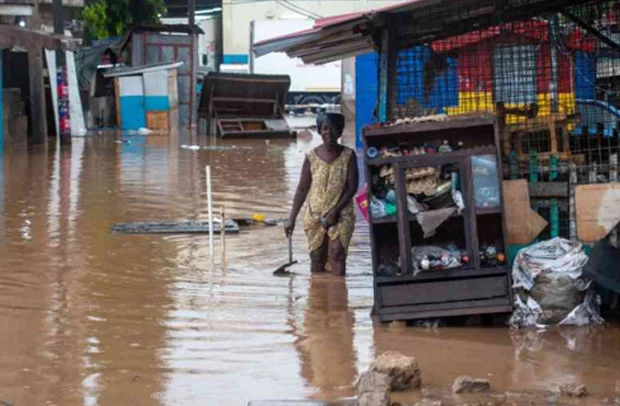
A woman wades through flooded area
Every rainy season, the story is painfully familiar. Dark clouds gather over Accra, heavy rains fall for a few hours, and soon, roads become rivers, homes are submerged, businesses are disrupted, and lives are sometimes lost. The immediate reaction is often to blame the intensity of the rainfall. Yet the truth is that Accra’s flood crisis is far bigger than the rain itself.
Rain does not kill. Rain merely exposes the weaknesses that have accumulated over decades: poor urban planning, weak enforcement of building regulations, uncontrolled development, disappearing wetlands, inadequate drainage infrastructure, and widespread civic indiscipline. Until these underlying issues are addressed, every major downpour will continue to produce the same tragic headlines.
The rapid expansion of Accra has outpaced the city’s planning systems. Residential and commercial developments have sprung up in waterways, flood-prone zones, and wetlands that once served as natural buffers against flooding. Many structures that should never have received permits have been allowed to remain, while enforcement agencies often appear powerless, or unwilling, to act. The result is a city increasingly unable to absorb or channel storm water effectively.
Equally troubling is the condition of the capital’s drainage system. Drains that were designed to carry water away are frequently clogged with plastic waste, sand, debris, and silt. In many communities, residents continue to use drains as dumping grounds despite repeated warnings from authorities. When heavy rains arrive, these blocked channels inevitably overflow, turning streets and neighbourhoods into flood zones.
The destruction of wetlands presents another serious concern. Wetlands are nature’s drainage system, absorbing excess water and reducing the impact of floods.
Yet many of these critical ecological assets have been encroached upon or completely reclaimed for construction projects. The loss of these natural flood-control mechanisms leaves the city even more vulnerable whenever rainfall intensifies.
However, it would be unfair to place all the blame on government institutions. Citizens also have a responsibility to protect their communities. The indiscriminate disposal of refuse into gutters, drains, streams, and open spaces contributes significantly to the flooding problem.
Public education campaigns have been conducted for years, but behavioural change has been slow. A city cannot function effectively when a significant number of its residents disregard basic environmental sanitation practices.
That said, government officials bear the greater responsibility because they possess the legal mandate and resources to enforce compliance. Metropolitan, municipal, and district assemblies must move beyond annual desilting exercises and emergency responses.
What is required is a comprehensive and sustained flood management strategy that prioritises proper drainage infrastructure, strict enforcement of planning regulations, protection of wetlands, and the removal of structures obstructing waterways.
The political will to undertake these measures is often tested because enforcement actions can be unpopular. Yet leadership demands difficult decisions. Delaying action only increases the human and economic costs of future floods.
Climate change is expected to make rainfall patterns more unpredictable and, in some cases, more intense. This means Accra cannot afford to continue treating floods as seasonal emergencies. They are now a recurring urban management challenge requiring long-term planning and investment.
The next heavy rainfall is not a matter of if, but when. The question is whether authorities and citizens will finally learn from the repeated disasters of previous years. If they fail to act, the next flood will once again expose the same weaknesses, destroy the same properties, threaten the same lives, and generate the same promises of reform.
Accra deserves better. Preventing floods is not solely the responsibility of government, nor is it solely the duty of citizens. It requires a collective commitment to responsible governance, effective enforcement, environmental protection, and civic discipline. Until that happens, the rains will continue to reveal not just a flooding problem, but a failure of shared responsibility.
By Ernest Kofi Adu