
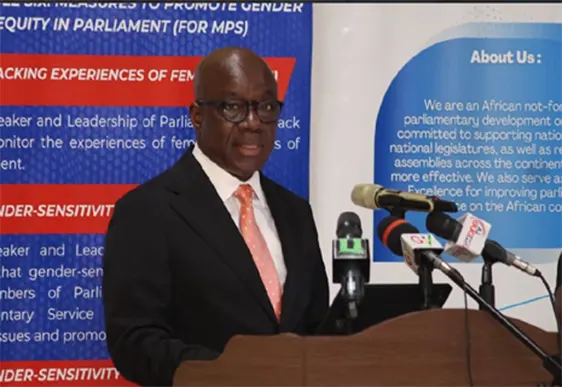
Dr. Rasheed Draman
Gender responsiveness must move from being a project objective to becoming an institutional habit, the Executive Director of the African Centre for Parliamentary Affairs (ACEPA), Dr. Rasheed Draman, has stated.
Speaking at the closing ceremony of the Inclusive Legislatures for Gender Responsive Policies (ILGRP) project, he said the project was built on a simple but powerful proposition: that legislatures cannot fully deliver on their democratic mandate if their policies, processes, cultures and resource allocation systems do not respond to the different needs of women and men.
Dr. Draman said gender responsiveness is not simply about the number of women in Parliament.
Outlining three key messages, he said first, gender responsiveness is not a favour to women but a requirement for effective and accountable governance. According to him, Parliament must always ask who benefits from a decision, who might be left behind, and what can be done.
He noted that budgets that ignore the realities of women and girls fail to address barriers to education, healthcare and economic participation. Second, he warned that what is not institutionalised is at risk of being lost. He said the policies, tools and capacities developed through ILGRP must find a permanent home within Parliament’s systems, including planning, human resource management, budgeting and oversight.
Deputy Clerk in charge of Legislative Management Services, Camillo Pwamang, said the project which commenced in April 2023, was not just a conventional technical assistance intervention but a collaborative partnership founded on institutional ownership, mutual accountability and co-creation of sustainable outcomes.
Mr. Pwamang said the closing ceremony goes beyond a ceremonial closure, providing an opportunity for Parliament, ACEPA and stakeholders to reflect on collective achievements, celebrate successes, assess contributions to institutional capacity development and explore opportunities for sustaining the gains.
“The significance of these tools extends beyond their immediate application. They provide an opportunity to institutionalise knowledge and skills, reduce dependence on individual expertise and ensure continuity in gender-responsive approaches,” he stressed.
While the formal implementation period is ending, he said the broader objective of building an inclusive and gender-responsive Parliament remains an ongoing responsibility.
He assured that the Parliamentary Service is committed to integrating the achievements of the project into its broader institutional reform agenda as contained in its strategic plan for 2026 to 2030, to ensure investments translate into lasting improvements in performance and inclusive governance.
Meanwhile, the Canadian High Commission has described the successful completion of the Inclusive Legislatures for Gender Responsive Policies project as another important milestone in its long-standing partnership with the Parliament of Ghana.
International Assistance Officer at the Canadian High Commission, Yaa Nkansah Asamoah-Aning, said the partnership entered a new chapter in 2022 with the launch of the ILGRP project, designed to support Parliaments in Ghana, Togo and Kenya to become more gender-responsive and representative institutions.
The initiative, she said, aligns with Canada’s broader commitment to supporting women and youth-led enterprises, sustainable economic growth and inclusive employment.
She said across Ghana, Togo and Kenya, the project helped parliaments identify institutional gaps and develop their own strategies to integrate gender and intersectional analysis into legislative, budgeting and oversight functions.
It also strengthened engagement between parliaments and civil society, including women’s rights organisations, ensuring that voices and lived experiences of women and girls are reflected in public policy. She highlighted that in Ghana, gains contributed to the passage of two landmark laws — the Affirmative Action Act 2024 and the Social Protection Act 2025. She stressed that for sustainability, the tools and capacities developed must be embedded in the daily culture and work of Parliament.
The Inclusive Legislatures for Gender-Responsive Policies (ILGRP) project was implemented by the African Centre for Parliamentary Affairs (ACEPA), the Parliamentary Centre and the Parliament of Ghana, with funding from Canada’s International Development – Global Affairs Canada.
By Prince Fiifi Yorke