
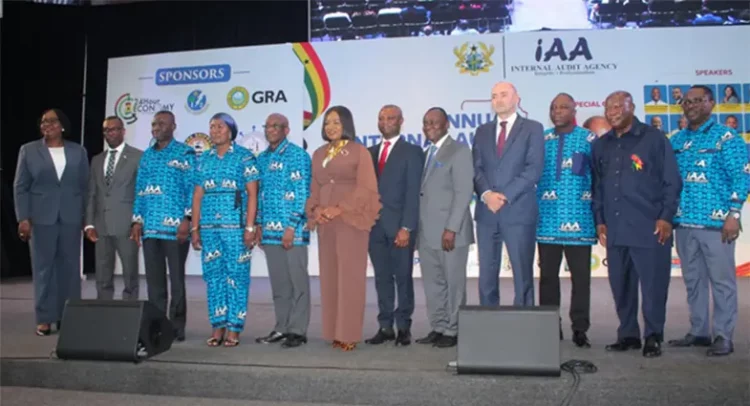
Officials in a group photograph
The Director-General of the Internal Audit Agency (IAA), Conrad Z. Dumbah, has highlighted significant gains in public sector financial accountability, including an 84.7 percent resolution rate for reported infractions in 2025, the near-complete establishment of targeted audit committees and the impending passage of the Internal Audit Bill.
He said the proposed legislation would transform the agency into a fully-fledged authority, strengthening its capacity to promote accountability and enforce compliance across the public sector.
Speaking at the Annual Internal Audit Conference, held under the theme, “Internal Audit and Ghana’s Reset Agenda: Strengthening Controls, Safeguarding Public Resources and Driving Economic Resilience”, Mr. Dumbah emphasised that internal auditing should serve as a proactive strategic management tool rather than a punitive “witch-hunt” exercise.
He said internal auditors should provide real-time assurance and serve as a “four-eye check” for heads of institutions before financial commitments were finalised, instead of allowing external auditors to uncover irregularities later in the year.
Across the public sector, he said internal auditors reported approximately 3,565 infractions in 2025, with 84.7 percent of the cases appropriately addressed.
Mr. Dumbah identified information technology (IT) audits, cybersecurity, data protection assurance and business continuity management (BCM) as strategic priorities.
He observed that technical capacity in these areas remained at an “infantile stage” across the public sector, requiring deliberate investment and capacity development.
Delivering the keynote address on behalf of President John Dramani Mahama to officially open the 2026 Annual Conference, former Finance Minister, Seth Terkper, stressed that sustainable national growth and prosperity depended not merely on policies, good intentions or natural resource endowments, but also on strong institutions, effective controls and a culture of accountability and integrity.
He urged greater reliance on local accounting and auditing expertise rather than foreign firms.
Mr Terkper also welcomed the establishment of a Value for Money unit at the Ministry of Finance to address weaknesses in contract valuation and debt restructuring “haircuts”.
He further called for clear institutional boundaries to ensure that human resource functions remained with the Public Services Commission, the Office of the Head of the Civil Service and the relevant service boards.
He urged public sector leaders and internal auditors to move away from explaining infractions after they occurred and focus instead on preventing financial lapses.
The Acting Vice-Chancellor of Accra Metropolitan University and Chairperson of the Annual Internal Audit Conference, Professor Goski Alabi, said quality should be built into processes from the outset rather than inspected afterwards.
“As this year’s theme highlights, strong controls, public resource protection, and economic resilience depend on internal auditors’ independence, sound reporting lines, and management’s willingness to act on audit findings rather than merely having strong legal frameworks,” she said.
By Janet Odei Amponsah