
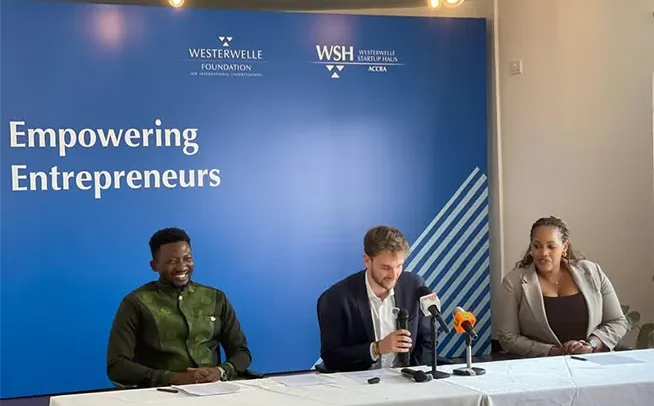
Westerwelle Startup Haus Accra, has been launched in Labone, to focus on green and digital transformation and the creative economy, alongside partners to design initiatives that fit and respond to ecosystem demand.
The new hub offers co-working space for up to 180 members, structured programmes, and a network that connects founders with partners and investors.
For founders in Ghana, this provides access to a workspace, programmes, and connections to international partners, markets, talent, and capital. For German and international companies, it offers direct access to Ghana’s entrepreneurial community through a local team that makes the right connections, while also serving as part of a pan-African network linking Ghana with the Foundation’s hubs in Tunisia, Rwanda, Tanzania, and Kenya.
The country director for the Westerwelle Foundation in Ghana, Alhassan Muniru, announced the opening of Westerwelle Haus Accra, describing it as a new home for Ghanaian founders. With capacity for up to 180 members and a board of 100, the initiative is built on the belief that a Ghanaian founder should be able to build in Ghana and sell to the world.
”Having seen this progress closely through its Young Founders programme, which supported ventures tackling local challenges in waste, food, and packaging, such as a product called “The Sun” (a company of complete farmers) and Soko (a developer), the foundation aims to open doors for many more entrepreneurs without building their companies for them,” he said.
He reiterated that, Westerwelle Haus Accra brings two key offerings to the table: first, physical infrastructure including workspace for up to 180 members, private offices, training rooms, event spaces, a cafe, and an outdoor space, designed as a one-stop shop where founders can meet co-founders, investors, accountants, lawyers, and clients under one roof.
Second, it provides impact-driven programmes supporting entrepreneurs, startups, and young people from their very first idea until they are ready to grow.
Open to every sector, he mentioned that the haus will begin with programmes focused on digital and green innovation and the creative economy, growing alongside partners to design initiatives that fit and respond to ecosystem demand.
Managing Director, Paul Steffens, Westerwelle Foundation, said the Westerwelle Foundation, a German non-profit organisation based in Berlin that supports the early-stage entrepreneurs across Africa, was founded in 2013 by Guid Westerwelle, former German Foreign Minister and Vice Chancellor, and serial entrepreneur Ralph Dommermuth.
He highlighted that over the years, Westerwelle Foundation has been of great impact to entrepreneurs, helping open doors to new markets and sources of capital, adding that since 2016, they have opened five hubs.
The first one, he said, was opened in 2016 in Tunisia, then two years later “we opened in Rwanda, in Kigali, two, three, four years later in Tanzania, in Arusha, then another two years later we opened in Kenya, and now two years later we’re opening in Ghana. You see a kind of trend.”
”Through those past 13 years we have now been supporting over 2,400 entrepreneurs, created jobs, more than 1,200, and had different styles of programmes along those 13 years. And the main belief is in young talent. We believe that young talent can make great things happen if they get access to the right resources and the right networks, and our hubs exist to open up that access,” he said.
”The Westerwelle Foundation in Ghana was built on a simple belief, and that is to give young people access to the right resources and networks, and they will make great things happen. Today that creates real business opportunities for African and German companies alike. Accra is not just a project with an end date, it is a long-term partnership, built together with Ghana’s founders,” Mr. Steffens stated.
The Regional Expansion Lead, Westerwelle Foundation, Sarah Rukundo, stated that rather than running short-term projects, they build long-term spaces “by partnering directly with the country and local ecosystem for as long as we are needed.”
She emphasised that Ghana’s ecosystem helped shape their presence, guiding where they house entrepreneurs and how they support them, stressing, “We continue to stay aligned with that approach today: collaborating rather than working in silos or duplicating existing efforts.”
By Janet Odei Amponsah