
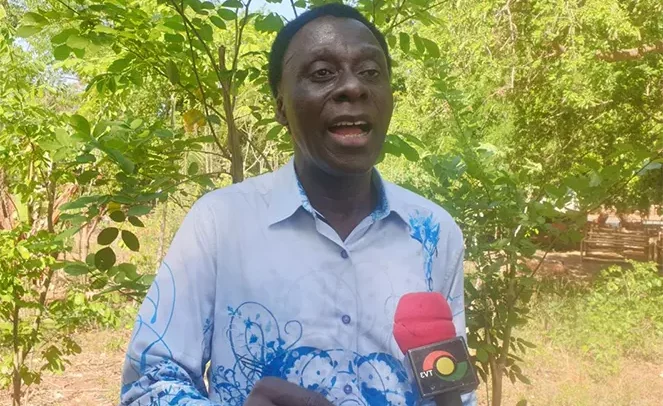
Nana Dwomoh Sarpong
Friends of Rivers and Waterbodies, a non-governmental organisation, has commended the government for restoring the Achimota Forest to its original legal status as a Forest Reserve, describing the decision as an important victory for environmental protection and the future of Accra.
The environmental group stressed the need for future governments to respect and preserve the legal status.
Cabinet, on June 24, 2026, approved the revocation of Executive Instrument (E.I.) 144, as amended by E.I. 234, thereby restoring the affected portions of the Achimota Forest to their original status as part of the Forest Reserve. The decision reversed the 2022 action which removed approximately 361.5 acres from the reserve.
Bold, Necessary Decision
In an interview, the President of Friends of Rivers and Waterbodies, Nana Dwomoh Sarpong, commended President John Dramani Mahama and the government for what he described as a bold, responsible and necessary decision.
“We at Friends of Rivers and Waterbodies commend President Mahama and the government for this bold step,” he said.
Nana Sarpong noted that environmental organisations and citizens have consistently criticised successive governments when forests and other natural resources are not adequately protected.
“If the government has taken a decision to protect this forest, we must also commend them. We urge future governments never to tamper with the protection of the Achimota Forest,” he stated, adding, “Achimota Forest must remain a Forest Reserve.”
“This is not about one political party or one government; it is about Ghana, our environment and the generations that will come after us,” he stated.
He called on the Ministry of Lands and Natural Resources, the Forestry Commission and other relevant state institutions to ensure that the restored status of the forest is fully respected and effectively enforced.
“This forest is very important. It is a very important national asset, not only for Accra but for the entire country,” Nana Sarpong stressed.
National Environmental Asset
According to him, the Achimota Forest must not be viewed simply as a piece of valuable land within Accra, but as an essential environmental asset whose benefits extend far beyond its immediate location.
“The forest contributes to the ecological health and resilience of the capital by providing green space, supporting biodiversity, improving air quality, helping to regulate urban temperatures and contributing to the management of environmental risks, including flooding.
“The forest’s role as an ecological safety zone for Accra and surrounding communities has also been highlighted by the government,” he stated.
Nana Sarpong warned that once critical urban forests are destroyed, replacing their ecological functions is extremely difficult, if not impossible, within a generation.
“We must think about the future. We cannot continue destroying trees and green spaces in the name of development and then expect to reverse the environmental damage later,” he said.
Future Generations
The environmentalist further emphasised that trees are fundamental to environmental sustainability and human well-being, contributing to cleaner air, carbon storage, biodiversity conservation, temperature regulation and the overall ecological balance of urban areas.
He therefore urged Ghanaians to view the protection of the Achimota Forest as a national responsibility rather than a political issue.
“Governments will come and go, but the environment will remain with us. The Achimota Forest belongs to the nation and future generations. It must therefore be protected beyond political administrations,” he said.
Green Spaces
Nana Sarpong further called for stronger enforcement of Ghana’s building, planning and environmental requirements to ensure that urban development does not come at the expense of trees and green spaces.
He pointed to the Ghana Building Code, which includes provisions relating to landscaping, tree shading and measures to reduce urban heat through appropriate site design and greenery.
He expressed concern about the continued removal of trees during construction and the increasing loss of green spaces in Accra.
“We cannot build a city by removing every tree. Development must go together with environmental responsibility,” he said.
He called on developers, property owners, local authorities and planning institutions to ensure that existing trees are preserved wherever practicable and that new developments incorporate adequate greenery and environmentally responsible landscaping.
Stressing the importance of green spaces, he said his organisation would continue to push for all stakeholders to support the full protection of the Achimota Forest and other remaining urban green spaces across Ghana.
A Daily Guide Report