
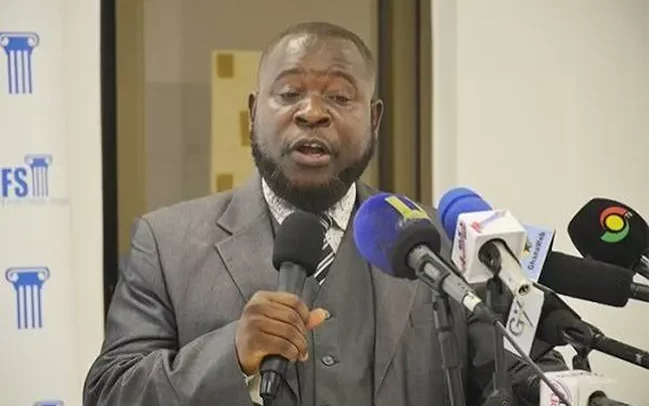
Dr. Said Boakye
The Institute of Fiscal Studies (IFS) has urged the government to improve the implementation of the 2026 budget by ensuring that approved expenditure are fully implemented as budgeted.
Executive Director of the Institute of Fiscal Studies (IFS), Dr. Said Boakye, who made the call during a presentation and analysis of the Mid-Year Budget Review said although the country’s macroeconomic environment had remained relatively stable, weaknesses in budget implementation could undermine government’s fiscal credibility.
The IFS in its assessment of the 2026 Mid-Year Budget Review identified significant shortfalls in revenue mobilisation and expenditure execution during the first half of the year.
According to the IFS analysis, total revenue and grants for the first half of 2026 amounted to GH¢124.78 billion, falling short of the budget target of GH¢126.14 billion by GH¢1.37 billion, representing a 1.1 per cent deviation.
“It is, therefore, regrettable that the government ignored the financing plan in the budget during the first half of 2026 by accumulating resources in the Sinking Fund, something that had not been planned for, creating complications for spending on important items like capital expenditure and arrears payment. Going forward, the government should ensure that financing decisions are consistent with the budget plan,” he said.
Dr. Boakye indicated that tax revenue also underperformed, recording GH¢103.77 billion compared with a target of GH¢105.26 billion, resulting in a shortfall of GH¢1.49 billion noting that non-tax revenue was a major contributor to the revenue gap, recording GH¢12.27 billion against a target of GH¢14.90 billion.
He said the underperformance was largely driven by lower-than-expected dividend, interest and profit receipts from the oil sector, which fell short of the target by GH¢1.43 billion, representing 37.1 per cent.
The IFS however noted that proceeds from the Energy Sector Levies Act (ESLA) performed above expectations, generating GH¢7.69 billion compared with a target of GH¢4.21 billion.
The Institute also expressed concern about the significant gap between planned and actual government spending, noting that expenditure execution was below the approved budget.
The Executive director stated that though government had planned to spend GH¢172.54 billion, including arrears payments, in the first half of 2026, actual expenditure fell short by GH¢35.60 billion, representing 20.6 per cent while Capital expenditure recorded the largest shortfall, declining by GH¢14.38 billion or 39.3 per cent below target, with arrears payments falling short by GH¢8.64 billion, representing 61.8 per cent.
The Institute said considerable underspending in the first half of 2026 does not only undermined the credibility of the budget, but left much to be desired in terms of growth and development while asking the government to make forecasting more evidence-based demonstrating that nominal GDP, real GDP growth rate, and total revenue and grants to GDP ratio targets for 2026 are realistic.
“Devise a strategy to generate revenue from the small-scale gold mining sector: To strengthen revenue mobilization, the government needs to devise a strategy for generating revenue from the rapidly expanding small-scale gold mining sector.
“Ensure the consistency and reliability of fiscal data: The Ministry of Finance should ensure that fiscal data go through robust validation and verification processes before incorporating them into the budget statement in order to eliminate data inconsistencies,” he added.
By Ebenezer K. Amponsah