

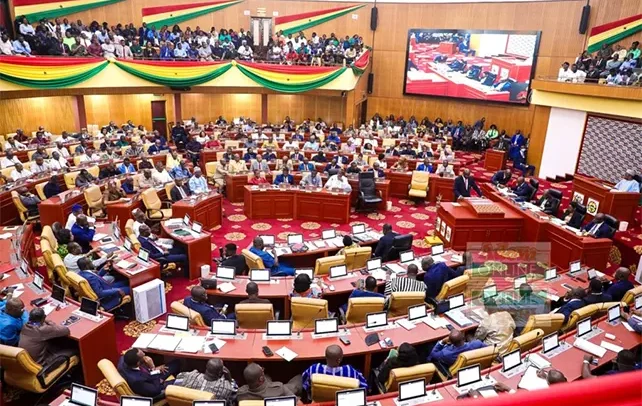
Parliament has passed the Legal Education Reform Bill, 2025, which marks a major shift in the structure and delivery of professional legal training in the country.
The bill, now read the third time, seeks to overhaul the country’s legal education system by separating the regulation of legal education from the regulation of the legal profession, a framework that has remained largely unchanged for over six decades.
At the heart of the reforms is the establishment of a new regulatory body, the Council for Legal Education and Training (CLET), which will assume responsibility for overseeing professional legal education.
The CLET will replace the General Legal Council in matters relating specifically to legal training, while maintaining strong collaboration with the Bar to uphold standards.
The legislation addresses longstanding concerns about the limitations of the current system governed by the Legal Profession Act, 1960 (Act 32), which combines the regulation of legal education and legal practice under one body.
Critics have argued that this arrangement has contributed to inefficiencies and inadequate attention to the evolving demands of legal training.
For decades, the Ghana School of Law has operated as the sole institution responsible for professional legal education.
However, increasing demand driven by the expansion of law faculties across universities in the country and abroad has exposed significant capacity challenges.
While the system once accommodated relatively small numbers, mainly graduates from the University of Ghana, recent years have seen a surge in qualified applicants, far exceeding the School’s infrastructure and resources.
The new law seeks to resolve this bottleneck by decentralising professional legal training. Under the reforms, accredited universities will now offer a Law Practice Training Course designed to equip students with practical legal skills through clinical legal education.
Graduates holding a Bachelor of Laws degree will be required to enroll in this programme before sitting for a newly introduced National Bar Examination, which will serve as the standardised pathway to legal practice.
The lawmakers said the reforms aim to expand access to legal education while maintaining high standards in training and professional competence.
The Council for Legal Education and Training will be tasked with licensing and accrediting universities to run the programme, as well as setting curriculum standards.
It will comprise experienced members of the Ghanaian Bar and academia, ensuring a balance between professional oversight and academic excellence.
Despite the structural changes, the Attorney General will continue to serve as the minister responsible for legal education and training.
By Ernest Kofi Adu, Parliament House