
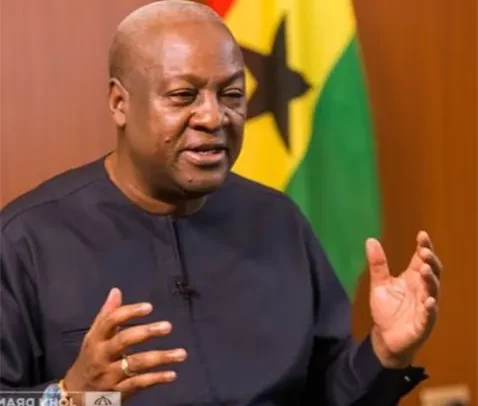
President John Dramani Mahama
President John Dramani Mahama has proposed that factories operating under the government’s 24-hour economy initiative be allowed to import machinery and equipment duty- and tax-free when expanding or retooling their operations.
He made the announcement at the sod-cutting ceremony for a new float glass manufacturing plant and the commissioning of a sanitary ware factory by KEDA (Ghana) Ceramics Company Limited in Shama in the Western Region.
The President disclosed that the proposal followed a recent engagement with private sector leaders, fulfilling a campaign pledge he made ahead of the 2024 general elections to hold regular dialogues with industry players.
“Yesterday, I held a dialogue with the private sector. I promised in 2024 that when I became President, we would organise an annual meeting where captains of industry could directly outline the challenges confronting them,” he stated.
According to him, one of the key concerns raised during the meeting was the high cost of duties and taxes imposed on capital equipment.
“One of the issues raised was duties and taxes on capital equipment. For factories registered under the 24-hour economy initiative, I have proposed that equipment imported for expansion or retooling should enter the country duty- and tax-free,” he announced.
President Mahama assured investors that the government is committed to supporting the 24-hour economy policy with concrete incentives aimed at boosting industrial growth and investment.
“The incentives are coming. Your confidence in Ghana will be rewarded with policies that promote even greater investment,” he said.
He also expressed appreciation to the traditional authorities in Shama for releasing close to 800 acres of land for industrial development.
Describing the area as an emerging industrial hub in the Western Region, the President noted that the factories are already contributing significantly to exports, with about 60 per cent of their output shipped to neighbouring African countries and other markets, including Europe and the United States.
“When you flip a tile and see ‘Made in Ghana,’ it fills us with pride,” he remarked.
He further urged workers at the facility to take ownership of the enterprise and safeguard it for future generations.
“Treat this factory as your own. It has provided you with jobs. If you protect it, your children and grandchildren will also benefit,” he added.
By Vera Owusu Sarpong