
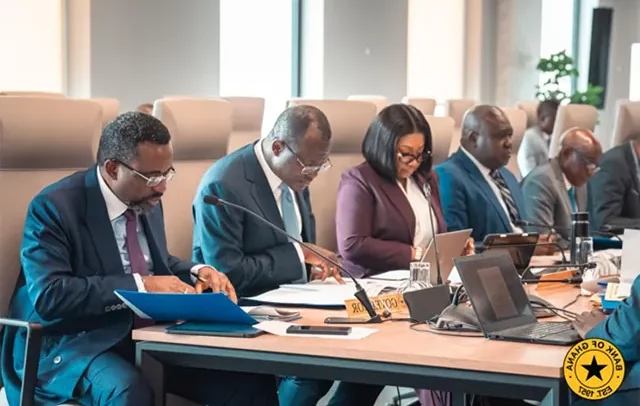
Dr. Johnson Asiama (R) with his deputies
The Governor of the Bank of Ghana (BoG), Dr. Johnson Asiama, says the conflict in the Middle East and rising global energy prices could pose significant risks to the country’s economic recovery, despite signs of strong domestic resilience and improving investor confidence.
Speaking at the opening of the 130th Monetary Policy Committee (MPC) meeting at the Bank Square in Accra yesterday, Dr. Asiama said the initial conditions of the Ghanaian economy had improved meaningfully since the Committee’s last meeting in March 2026, describing the development as “a testament to the sustained reform efforts in recent years.”
“At the same time, a deteriorating external environment, characterised by the ongoing conflict in the Middle East and its effects on global energy and commodity prices, is introducing new headwinds that must be weighed carefully,” he stated.
According to the Governor, at the129th MPC meeting earlier this year, policymakers were uncertain whether the Middle East conflict would be brief or prolonged.
As a result, the Committee developed different scenarios, including one in which Brent crude prices would return to around US$75 perbarrel and another in which prices could remain close to US$100 per barrel through the end of the year.
“Since then, a clearer picture of the Middle East crisis and its potential effects is emerging. The conflict has not abated, and its economic consequences are now visible in the global data,” he said.
Dr. Asiama revealed that the closure of the Strait of Hormuz had triggered a sustained rise in global energy prices, while the International Monetary Fund (IMF) had revised its 2026 global growth forecast downward to 3.1 percent from 3.3 percent due to disruptions linked to the conflict.
He further explained that several emerging economies were already recording renewed inflationary pressures, forcing some central banks to pause or reverse earlier monetary policy easing measures.
“For a commodity-exporting, energy-importing economy such as Ghana, the transmission channels of this external shock are multiple and material through fuel prices, transportation costs, import bills, and ultimately consumer price dynamics,” Dr. Asiama stated.
Despite the challenges, the Governor highlighted several positive developments within Ghana’s economy, citing easing inflation and the 2026 IMF World Economic Outlook projection of continued economic expansion for the country.
He also disclosed that the current account surplus for the first quarter of 2026 exceeded the same period in 2025 by approximately US$652 million.
By Ebenezer K. Amponsah