
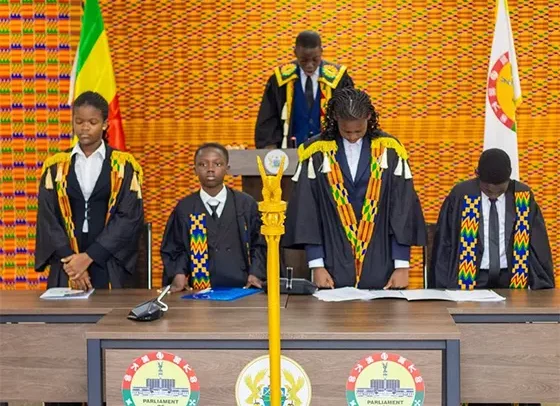
Parliament has launched a Mini Parliament initiative aimed at empowering children to participate in national discourse and contribute meaningfully to the nation’s development.
The programme, which was organised by the Parliament in collaboration with the African Centre for Parliamentary Affairs (ACEPA), UNICEF and the Learning Tree Foundation, seeks to provide children with a practical platform to debate national issues and understand parliamentary procedures.
Speaking at the launch in Parliament House, the Chairperson of Parliament’s Committee on Gender, Children and Social Protection and Member of Parliament for Krachi West, Helen Adjoa Ntoso, stressed the need for stronger engagement mechanisms to help young people realise their potential.
She noted that the era when governments solely designed and implemented policies for underrepresented groups without citizen participation was over, adding that young people increasingly demand opportunities to be heard in decision-making processes.
According to her, the shift reflects Ghana’s commitment to transparency, openness and public trust.
The Chief Social Policy and Inclusion Officer at UNICEF, Ms. Paulina Sarvilahati, underscored the importance of child participation in national development.
She reminded participants that Ghana was the first country to ratify the United Nations Convention on the Rights of the Child, which guarantees children the right to freely express their views on matters affecting them.
“You deserve to be heard. You deserve to be protected. You deserve to go to school and achieve your dreams,” she told the children, while encouraging them to speak confidently and boldly.
The Coordinating Director of Public Affairs at Parliament, Kate Addo, commended the children for their confidence, eloquence and active participation during the maiden sitting.
She urged them to remain disciplined, committed to academic excellence and actively interested in national affairs, noting that leadership begins with integrity, responsibility and service.
Speaking on the rationale behind the initiative, the Director of Public Engagement at Parliament, Supt. (Rtd) Effia Tenge, disclosed that more than 44,000 people visited Parliament under its educational programme between 2023 and 2025, with over 70 percent being primary and junior high school pupils.
She explained that although many children showed interest in understanding parliamentary work, they often struggled to fully grasp parliamentary procedures during visits.
According to her, the Mini Parliament initiative was therefore designed as an interactive learning platform where children could assume the roles of Members of Parliament and debate issues affecting young people.
“The vision is to ensure that the Ghanaian of tomorrow is capable of making meaningful contributions to national progress,” she stated.
The Executive Director of ACEPA, Dr. Rasheed Draman, praised Parliament for introducing an innovative initiative that promotes civic responsibility and inclusion among children.
During the maiden sitting, participants debated the topic, “Responsible Use of Technology by Children,” focusing on online safety, digital responsibility and the impact of technology on children’s wellbeing.
Officials from the Cyber Security Authority also educated participants on cyberbullying, internet safety and the protection of personal information online.
The Queen Mother of the Dzorwulu Abelemkpe Subdivision Stool, Manye Naa Badu Diaba I, also encouraged the children to uphold good moral values and work towards becoming responsible future leaders.
By Ernest Kofi Adu, Parliament House