
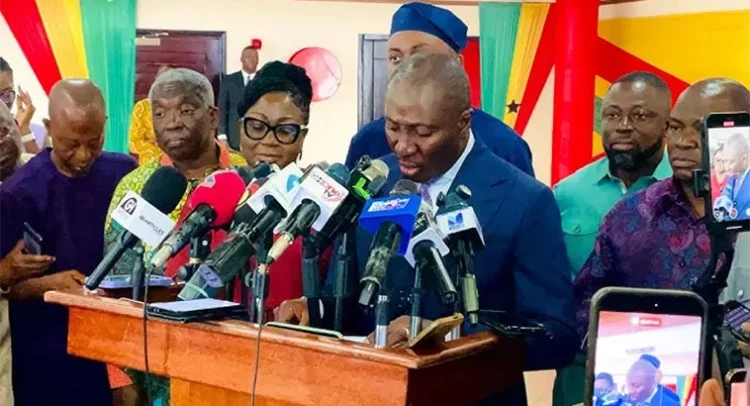
Alexander Afenyo-Markin flanked by Minority members
The Minority in Parliament has challenged the Ghana Gold Board (GoldBod) to account for an alleged GH¢22 billion loss incurred in 2025 through the domestic gold purchasing programme operated in collaboration with the Bank of Ghana (BoG).
Minority Leader, Alexander Afenyo-Markin, said the alleged loss, equivalent to about US$1.7 billion, was contained in the latest International Monetary Fund (IMF) report on Ghana, and demanded urgent explanations from GoldBod on the circumstances that led to the financial losses.
Addressing a press conference in Parliament yesterday, Mr. Afenyo-Markin said the Minority’s concerns were not personal or politically motivated but were based on findings contained in the IMF’s report.
He said the IMF had attributed the losses to a combination of service and assay fees paid by GoldBod, discounts on gold sold to off-takers and, most significantly, exchange rate losses arising from the difference between the rates used to purchase gold and the reference rate used by the BoG for accounting purposes.
According to him, the IMF report indicated that the losses amounted to US$1.7 billion, representing about 1.5 percent of Ghana’s Gross Domestic Product (GDP) in 2025.
He argued that the magnitude of the loss required GoldBod and the government to provide detailed explanations to taxpayers, particularly because GoldBod played a central role in the gold purchasing, aggregation, assaying and export processes.
“Who are the off-takers? Why were sales discounted? And why is the mandate to trade gold on the country’s behalf producing losses the country was never told about?” Mr. Afenyo-Markin asked.
He rejected the argument that the losses could be attributed solely to the BoG because the transactions were carried out on behalf of the central bank.
The Minority Leader said although the losses appeared on the BoG’s books, GoldBod could not distance itself from the financial consequences of transactions it operationally managed.
He said GoldBod was responsible for buying, weighing, grading, assaying, valuing and exporting gold, while the BoG provided the financing.
According to him, GoldBod also earned fees from the transactions, raising questions about the allocation of risks and rewards between the two institutions.
“A business model where one entity earns fees and another absorbs losses requires scrutiny,” he said, arguing that such an arrangement could create a moral hazard where an institution benefited from transaction volumes without bearing equivalent financial risks.
Mr. Afenyo-Markin therefore demanded information on the prices paid for gold, how those prices were determined, the premiums paid to suppliers, the selection of international off-takers, the discounts applied to gold sales and the fees earned by GoldBod.
He also asked GoldBod to disclose the commercial risks it identified, the safeguards put in place to protect BoG funds, and the corrective measures taken as the losses accumulated.
The Minority Leader said the issue could not be resolved by pointing to GoldBod’s reported profitability, insisting that the profitability of GoldBod as an institution was different from the profitability of transactions it executed for the BoG.
“A middleman can earn a profit while the principal loses money,” he said, adding that the central question was whether Ghana received value for the financial risk it assumed.
Mr. Afenyo-Markin further cited GoldBod’s decision to end its role as buying agent for the BoG as evidence that the existing arrangement required closer scrutiny.
He said GoldBod had announced on August 11, 2026 that it had ended its role as the BoG’s buying agent and had ceased receiving BoG funds for gold purchases since March 2026.
He said GoldBod had indicated that it was transitioning towards mobilising financing directly from commercial banks and off-takers.
The Minority Leader also recalled that concerns had earlier been raised about the fees charged under the programme, leading to an emergency joint meeting between GoldBod and the BoG and a subsequent review of the fees.
Mr. Afenyo-Markin said the initial fee structure, which he claimed was about 15 percent, was reduced to nine percent following concerns raised by the Minority.
He maintained that the subsequent changes did not answer questions about the GH¢22 billion loss.
He also criticised the GoldBod Chief Executive for dismissing concerns raised by Minority figures and attacking members of the caucus instead of addressing the substantive issues.
Mr. Afenyo-Markin said the Minority would pursue the matter in Parliament when the House reconvened next week.
He disclosed that the caucus would file a motion on the GH¢22 billion loss and urged the Majority not to use its numerical strength to prevent the GoldBod Chief Executive from appearing before Parliament.
“The GoldBod CEO has thrown a challenge that he is ready to debate us,” he said, adding that Parliament should invite him to account for the alleged losses.
The Minority Leader said the issue was one of public accountability rather than partisan politics, and warned that the financial implications could ultimately be borne by taxpayers.
He said the Minority would continue to press for answers because, in his view, the alleged loss represented resources that could otherwise have been used for hospitals, schools, roads and other public infrastructure.
By Ernest Kofi Adu, Parliament House