
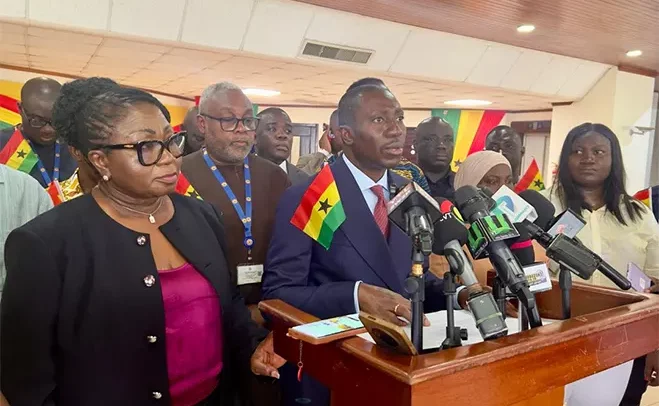
Alexander Afenyo-Markin, addressing the press
The Minority in Parliament has rejected attempts by the Majority to fast track the vetting and approval of three nominees to the Supreme Court before the House rises today.
The Minority Leader, Alexander Afenyo-Markin, who made the position known at a press conference in Parliament yesterday, said the caucus was not opposed to the nominations but would not support “an unnecessary rush” that could undermine the legitimacy of the judicial appointments.
As Mr. Afenyo-Markin read the statement, the Minority Members of Parliament (MPs) stood behind him, waving the national flag and singing the patriotic songs of the nation.
The three Supreme Court nominees are Justice Sophia Bernasko Essah, Justice Amoako Asante and former Ghana Bar Association President, Anthony Forson Jnr.
The Minority Leader said the three nominees deserved adequate scrutiny and public participation before their consideration by the Appointments Committee.
He said the Minority was, however, prepared to vet the two ministerial nominees, Mahama Ayariga and Dr. Zanetor Agyeman-Rawlings, within the current emergency recall of Parliament.
According to him, Article 78(1) of the Constitution entrusted Parliament with the responsibility of approving ministerial nominees and the Minority was ready to discharge that duty fairly and promptly.
He said the situation was different with the Supreme Court nominees because Parliament’s Standing Orders required their names to be published to enable members of the public to submit memoranda.
The Minority Leader cited Standing Order 217(10), which, he said, required the publication of the names of nominees to allow the public to participate in the process.
He also referred to Standing Order 217(2), which requires the chairperson, ranking member and two other members of the relevant subject matter committee to join the Appointments Committee for consideration of nominees.
He, therefore, rejected an interpretation of Standing Order 217(11) that the Appointments Committee was required to complete the entire vetting process within three days of the referral of the nominees.
Mr. Afenyo-Markin accused the Majority of seeking to use its numerical strength to “stampede” the committee into vetting the three nominees within the remaining period of the emergency sitting.
He recalled that in 2024, when the then President Nana Akufo-Addo nominated two persons to the Supreme Court, the National Democratic Congress (NDC) Minority, led by Dr. Cassiel Ato Forson, opposed their immediate vetting on the grounds that the public had not been given adequate notice.
He said the then NDC Minority had insisted on a 14-day minimum notice and that the Majority at the time had accepted the position and suspended the vetting to allow for public participation.
“Today, they are here claiming that just three days after the announcement of nominees on the House floor, there must be vetting and approval. We do not accept,” he said.
The Minority Leader said rushing the nominees through the process could create questions about their legitimacy that could follow them throughout their tenure on the Supreme Court.
He argued that every judgment delivered by a justice appointed through a “hurried process” could attract questions about whether the proper procedures had been followed.
Mr. Afenyo-Markin also challenged the argument that the appointments were urgent because the Supreme Court was on vacation.
He said the court was still capable of sitting during the vacation to deal with urgent matters and maintained that the administration of justice had not come to a halt.
“There is no vacancy, and there is no emergency,” he said, insisting that the three nominees were not being appointed to fill existing vacancies on the bench.
He said the court currently had a full complement of justices and could continue to hear and determine cases without the three nominees being immediately sworn in.
The Minority Leader contrasted the urgency surrounding the judicial nominations with the replacement of ministers who died in a helicopter crash in the Ashanti Region.
He said the President had waited for about a year before naming replacements for the ministers, despite those positions being genuine vacancies at the heart of government.
“If filling those two genuine ministerial vacancies that truly had been an emergency, the President would not have waited for that long,” he said.
The Minority also pointed to what it described as more pressing national emergencies, including alleged US$1.7 billion losses connected to Ghana Gold Board (GoldBod) and the Bank of Ghana, and the nationwide power outages.
Mr. Afenyo-Markin said the alleged losses, equivalent to about GH¢22 billion, required urgent parliamentary scrutiny because of their implications for the economy, public finances and confidence in the financial system.
He also described the persistent power outages as a genuine national emergency, citing their potential impact on hospitals, security installations, water systems and economic activity.
By Ernest Kofi Adu, Parliament House