
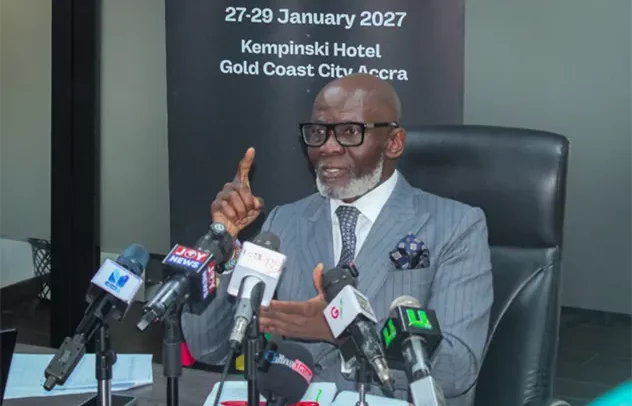
Gabby Asare Otchere-Darko
The Founder and Executive Chairman of the African Prosperity Network (APN), Gabby Asare Otchere-Darko, says implementing mobile money (MoMo) interoperability across Africa will serve as the fastest means to promote intra-African trade, particularly among small and medium-sized enterprises (SMEs).
Speaking at the launch of the Africa Prosperity Dialogues (APD) 2027 on the theme, “The Borderless Africa We Want: Move Freely. Pay Seamlessly. Trade More,” Mr. Otchere-Darko said enabling Africans to transact businesses seamlessly across borders would create new opportunities for businesses, transport operators, logistics companies, and investors among others.
“The position of the Africa Prosperity Network and its partners is that allowing mobile money interoperability to operate across borders on our continent is the quickest way to achieve enhanced intra-African trade,” he said.
He explained that if Africans could use their mobile money wallets to purchase goods across countries, it would stimulate demand, encourage investment and strengthen supply chains across the continent.
“If I can buy something with my mobile money wallet in cedis and someone, for instance, can receive it in cedis in Kenya, then the goods that are bought can be transported to Accra. You are creating an incentive for the transport and logistics sector that will carry those goods from one place to another. Investors will see that there is a market for our large population, and it makes financial sense for them to invest in transport and logistics businesses that will be able to carry goods from sellers to buyers,” he stated.
According to him, such a system would convince investors that Africa’s large population represents a viable market, thereby attracting investment into businesses that support cross-border trade, adding that mobile money had already transformed economic activities in Ghana and contributed significantly to financial inclusion, job creation and the growth of fintech companies.
Mr. Otchere-Darko also stressed the need for Africa to achieve visa-free travel among member states, describing the current situation where Africans face restrictions travelling within their own continent as unacceptable.
For his part, the National President of the Ghana Borderless Alliance, Ziad Hamoui, said Africa’s integration efforts must go beyond agreements and protocols to practical systems that allow people, goods and payments to move freely.
Mr. Hamoui noted that although Africa had established frameworks such as the African Continental Free Trade Area (AfCFTA), ECOWAS free movement protocols and digital payment systems, the continent was yet to fully realise their benefits.
He said intra-African trade remained relatively low despite Africa’s huge market potential, arguing that the focus should now shift from creating policies to making those policies work for ordinary citizens, describing freedom of movement as a critical economic infrastructure.
“Goods do not move by themselves. Supply chains require businesspeople, drivers, engineers, entrepreneurs, technicians and traders. If people cannot move easily across borders, neither can the businesses and value chains that depend on them,” he said.
He disclosed that the Ghana Borderless Alliance was seeking to mobilise 10 million signatures to present to the African Union Heads of State Assembly in February 2027 to demand action towards easier movement and seamless transactions across Africa.
“The success of African integration should not be measured by how many agreements we sign. It should be measured by whether a trader crosses a border without unnecessary delay; whether a truck moves predictably along a corridor; whether an entrepreneur can do business across borders; and whether payment can move as easily as the goods and services being exchanged,” Mr. Hamoui added.
By Ebenezer K. Amponsah