
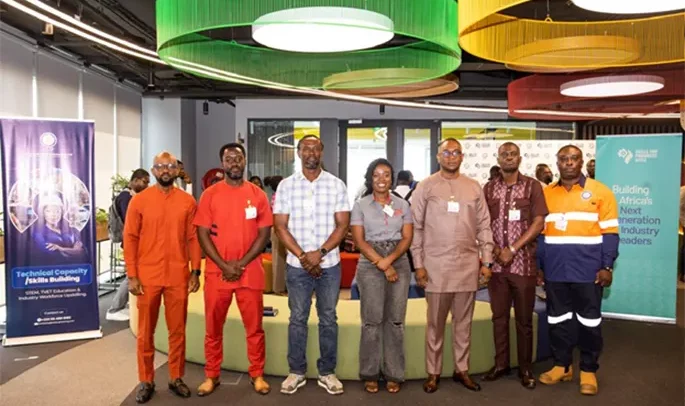
Officials at the launch
Skills for Progress Africa (SFPA) has officially launched in Accra with its first cohort of 10 Fellows under the theme ‘Building the Workforce That Will Build Africa’.
The launch, held at the Accra AI Community Centre at Google Ghana, brought together industry leaders, technical and vocational education and training (TVET) practitioners, policymakers and development partners to examine how Africa can better prepare its technical talent for industry demands.
The fellowship is being established with ELAF Industrial Automation Limited as its founding technical partner, combining technical training and practical industry exposure with personal, professional and leadership development.
Speaking at the launch, Executive Director of Skills for Progress Africa, Kwame Nyatuame, said the initiative is designed to bridge the persistent gap between technical education and industry readiness.
He said SFPA was founded on the premise that technical education must translate into workplace competence and opportunity.
“Education without experience is incomplete, and talent without opportunity is a tragedy,” Mr. Nyatuame said.
He explained that SFPA will identify promising technical talent, develop them to high industry standards, expose them to experienced professionals and connect them to companies and networks that can shape their careers.
According to him, the inaugural cohort is the first step towards a larger ambition of growing from 10 to 10,000 fellows, creating a scalable talent pipeline rather than a one-off training programme.
He called on industry, educational institutions and development partners to support the expansion.
Managing Director of ELAF Industrial Automation Limited, Solomon Bekoe, said the need for such a bridge is underscored by rising TVET enrolment alongside persistent challenges in transitioning from training to employment.
He noted that enrolment in pre-tertiary TVET programmes in Ghana increased by almost 130 percent over seven years, while youth unemployment among people aged 15-24 in Greater Accra reached 49.3 percent in the third quarter of 2025.”We don’t have an unemployment problem. We have a connection problem,” Mr. Bekoe said, describing the disconnect between education and competence, competence and industry, and industry productivity and youth opportunity.
He argued that employability and productivity are two sides of the same challenge. As founding technical partner, ELAF will provide structured technical training combining digital learning, AI-supported simulation and hands-on practical experience through the Festo LX platform.
Mr. Bekoe challenged companies hosting Fellows to make workplace attachments genuinely experiential by assigning real problems rather than limiting participants to observation.
Managing Director of Niche Cocoa, Lloyd Ashley, speaking from an industry perspective, focused on engineering culture, resilience and productivity. He said engineering culture is reflected in everyday behaviour, whether people report problems, ask questions, share knowledge and support younger professionals.
He described resilience as the ability to absorb pressure, adapt and keep moving forward, a quality important for both individuals and organisations.
On productivity, Mr. Ashley urged Fellows to focus on working smarter by simplifying processes, reducing downtime and using data and automation.
“I encourage you to build on the foundations established by those before you but you must also strive to improve upon them,” he said.
The launch also featured a panel discussion examining what African industry needs from technical talent, bringing together perspectives from manufacturing, TVET policy and international labour organisations.
Panelists examined the mismatch between demand for work-ready graduates and current curricula, and the uneven availability of industry partners outside major urban centres.
For the inaugural Fellows, the programme offers a bridge between classroom knowledge and industry realities, providing practical skills, mentorship and exposure to industry-standard tools.
As they progress, the Fellows will undergo structured training through ELAF and SFPA’s leadership development programme.
Organisers say the first cohort will be used to test, measure and refine the model to guide expansion to 100 Fellows and ultimately 1,000 and beyond.
The objective, according to SFPA, is to build a deeper pool of technically capable Africans ready to solve problems, improve productivity and contribute to the continent’s industrial development.
A Daily Guide Report