
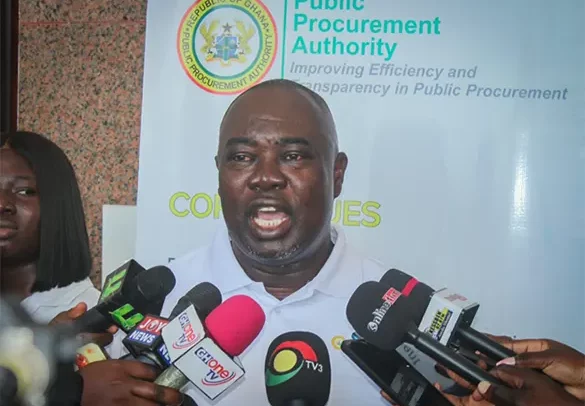
Frank Mante Esq. addressing the media
The Public Procurement Authority (PPA) has increased procurement thresholds to cut bureaucratic delays, with the threshold for goods under categories A, B and C now moved up to GH¢800,000.
The announcement was made at the 12th Procurement Forum held at the University of Professional Studies, Accra (UPSA), under the theme: “Deepening compliance for public procurement efficiency, transparency and effectiveness.”
The forum brought together stakeholders to discuss institutional updates and compliance in public procurement.
Speaking at the forum, the Chief Executive Officer of the PPA, Frank Mante, Esq., said the adjustment was made following feedback from previous forums.
He explained that the increase will reduce delays and eliminate the need for minor procurements to go through the Entity Tender Committee.
Mr. Mante said the PPA heavily promotes transparency through the Ghana Electronic Procurement System (GHANEPS), and encouraged private sector institutions to register on the system and receive training to fully participate in electronic procurement.
He said competitive tenders require strict transparency measures, including public advertisements and legally mandated explanations to unsuccessful bidders under Section 659 of the Public Procurement Act.
On sanctions, Mr. Mante warned that procurement breaches carry strict penalties under Section 92 of the law.
He said committing to procurement without financial authorisation from the Minister for Finance can lead to imprisonment under Section 92A, while heads of entities are held personally responsible for improper procurements under Section 17.
He noted that while the PPA acts as a regulator, it has limited regional offices in Accra, Takoradi and Kumasi, and resource constraints prevent a physical presence nationwide.
“The Authority actively conducts capacity-building training across the country, while internal audit units, investigations under Section 89, and the Auditor-General handle independent reviews of potential infractions,” he said.
Delivering remarks on behalf of the Minister for Finance, the Coordinating Director (Technical) at the Ministry of Finance, Samuel Arkust, said public procurement accounts for about 66 per cent of the national budget, translating to roughly GH¢37.1 billion.
He stressed that because procurement commands such enormous resources, transparency and compliance must be treated as a fundamental duty rather than a mere formality.
Mr. Arkust recalled the public expenditure reviews of the late 1990s that exposed severe weaknesses, uncoordinated processes and a lack of technical expertise in the sector.
“The passage of the Public Procurement Act 2003 (Act 663) and its subsequent amendments, such as Act 1039 in 2020, established central bodies and strengthened controls to bring much-needed accountability to public spending,” he said.
He emphasised individual accountability, stating that CEOs and management personnel bear ultimate responsibility for ensuring their organisations comply fully with procurement laws.
“Without this commitment, institutions risk circumventing established controls, leading to waste and potential statutory sanctions under Sections 96, 97 and 98 of the Act,” he stated.
He concluded by urging all stakeholders to view compliance as the bedrock of public trust, ensuring that every pesewa of national resources is managed with utmost fairness and transparency.
By Janet Odei Amponsah