
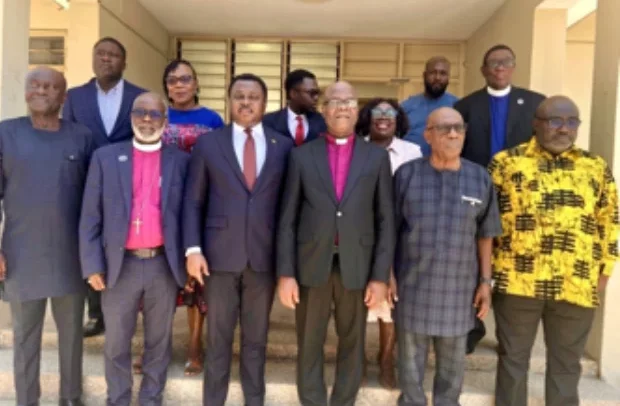
The Christian Council and NPP members after the meeting
The Christian Council of Ghana has called on state institutions to intensify investigations into the financing of narcotics trafficking and pursue the financiers, organisers and principal beneficiaries of the illicit trade rather than concentrating only on couriers.
The Council said the Presidency, Parliament, the Narcotics Control Commission (NACOC), the Financial Intelligence Centre (FIC) and the Judiciary must use their legal powers to trace the financial footprints of drug shipments and ensure that no person, irrespective of political or economic status, was beyond the reach of the law.
The Chairman of the Christian Council of Ghana, Reverend Enoch Nii Narh Thompson, made the call when the Council met with the opposition New Patriotic Party (NPP) Policy Committee on Security, Intelligence and Defence yesterday to discuss concerns over narcotics trafficking in the country.
He said the church’s intervention was based on both its spiritual mandate and its constitutional responsibility to support the maintenance of law and order.
Rev. Thompson cited Article 41 of the 1992 Constitution, which requires citizens to promote the prestige and good name of Ghana, foster national unity and cooperate with lawful agencies in maintaining law and order.
He also referred to the Narcotics Control Commission Act, 2020 (Act 1019), the Anti-Money Laundering Act, 2020 (Act 1044), and the Whistleblower Act, 2006 (Act 720), as legal instruments available to the state to combat narcotics trafficking and the illicit financial networks supporting it.
He said Act 1044 provided state agencies with powers to track, freeze and confiscate assets derived from criminal conduct, adding that the law should be used to deprive narcotics networks of their financial strength.
“Are we adequately pursuing the financiers, organisers and principal beneficiaries of the narcotic trade, or are we merely catching those at the bottom of the chain?” he asked.
Rev. Thompson said a justice system that punished desperate couriers while wealthy financiers were shielded would undermine the rule of law.
He further announced that the Council would support comprehensive financial investigations into narcotics shipments and called for greater transparency and institutional accountability in the handling of drug-related cases.
The Council also disclosed plans to strengthen its intervention against youth substance abuse through the “Sound Youth Sound Nation” programme, which it is implementing in partnership with the Ministry of Youth Development and Empowerment.
The programme, he said, would target substance abuse involving alcohol, marijuana, tramadol and other illicit drugs, with interventions including counselling, peer education and support systems in communities.
It also intends to strengthen grassroots engagement through local councils of churches, which would collaborate with law enforcement on civic education, community safety and the safe reporting of illicit activities.
The Meeting
The meeting followed an appeal by the NPP’s Policy Committee on Security, Intelligence and Defence for a non-partisan moral and spiritual intervention in the fight against narcotics trafficking.
The NPP delegation, led by the Ranking Member on the Defence and Interior Committee of Parliament, Rev. John Ntim Fordjour cited a number of narcotics-related incidents, including the reported interception of more than 3.3 tonnes of cocaine at Pedu Junction in Cape Coast, another consignment on the Takoradi-Cape Coast highway, and the seizure of 866 parcels of suspected cocaine concealed in sacks of gari at the Tema Harbour.
The party also raised questions concerning an aircraft incident at the Accra International Airport, the MV Sankofa affair and Ghana-linked narcotics seizures reported in Australia and France.
It said the incidents raised questions about whether investigations were adequately reaching the financiers and organisers of the trade.
The NPP proposed that religious leaders issue a joint pastoral statement condemning narcotics trafficking and demanding transparent and impartial investigations.
It also called for a national day of prayer and reflection, stronger youth protection programmes, institutional accountability and an interdenominational mechanism to sustain attention on the issue.
However, Rev. Thompson stressed that the Christian Council remained non-partisan and that its engagement should not be interpreted as an endorsement of any political party.
He said the Council’s position was a moral one because “crime has no political colour” and drug addiction did not discriminate on the basis of political affiliation.
The Council also proposed greater cooperation among religious bodies, including the Ghana Pentecostal and Charismatic Council, the Ghana Catholic Bishops’ Conference, Muslim and traditional religious communities, to create a coordinated response to organised crime.
At a press briefing after the meeting, Rev. Ntim Fordjour, urged Christian and other faith-based organisations to speak out against the narcotics menace without fear or favour.
He also criticised attacks on Catholic clergy and bishops on social media over their interventions on the drug issue, and called on government officials to condemn such attacks.
By Ernest Kofi Adu