
Restore Acheampong’s Military Rank To General -Sam Jonah To Mahama
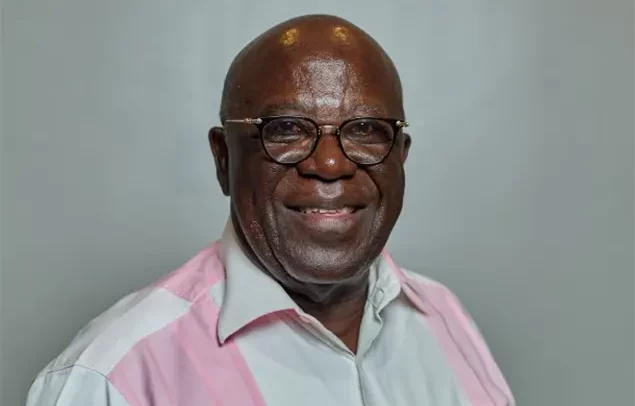
Business leader and Chancellor of the University of Cape Coast, Sir Sam Jonah, has appealed to President John Mahama to restore the military rank of General to former Head of State, Ignatius Kutu Acheampong, who was stripped of his rank before his execution in 1979.
Mr. Jonah made the appeal last Friday in Accra at the second General Ignatius Kutu Acheampong Memorial Lecture in Accra, held under the theme, “Breaking the Silence: The Human and Political Complexities Behind the Leadership of General Kutu Acheampong.”
“So I add my voice, respectfully, to those who ask His Excellency the President, the Armed Forces Council and, where the law requires it, Parliament, to do three things: restore the rank of General to Ignatius Kutu Acheampong; restore his name to the rolls of the Ghana Military Academy; and restore to his family the honours that belong with that rank”.
“As Ghana approaches seventy years, I can think of no better proof that this Republic is confident enough to tell its whole story. Restoring a rank does not rewrite history. It completes it. If the execution was an aberration, then so was the decree that sent him to it stripped of his rank,” he stated.
He also called for the restoration of Acheampong’s name to the rolls of the Ghana Military Academy and the return of the honours due his family which, in his view, would allow the country to acknowledge his place in its history fairly.
He said the country must be prepared to examine its entire political history, acknowledging both the achievements and shortcomings of past leaders rather than allowing their legacies to be defined by isolated events.
Mr. Jonah urged Ghanaians to assess Acheampong’s leadership within the political, economic and social circumstances of the period in which he governed.
He recalled that when Acheampong seized power on January 13, 1972, Ghana was experiencing serious economic difficulties under the administration of the late Dr. Kofi Abrefa Busia.
According to him, the country was grappling with falling cocoa prices, financial obligations, dwindling foreign reserves and the devaluation of the cedi by nearly half in December 1971.
He said the economic challenges, coupled with dissatisfaction within the military, over cuts to officers’ allowances, contributed to the political tensions preceding the coup.
Although Mr. Jonah maintained that the overthrow of an elected government was unacceptable, he argued that understanding the circumstances surrounding Acheampong’s rise to power was necessary for a balanced assessment of his leadership.
“None of this made the coup legitimate. Context explains; it does not excuse. Acheampong’s achievements and failures must be judged against the realities of his time,” he pointed out.
He also highlighted the National Redemption Council’s (NRC) decision, shortly after assuming power, to repudiate approximately US$90 million in suppliers’ credits believed to have been tainted by corruption, fraud and inflated contracts, while rescheduling other debts.
Mr. Jonah also identified Operation Feed Yourself as one of Acheampong’s most significant policy initiatives, describing it as a national agricultural mobilisation that encouraged Ghanaians to produce food locally and reduce dependence on imports.
He said the programme, which involved the distribution of subsidised agricultural inputs, investment in irrigation infrastructure and the development of feeder roads, recorded significant results, including the elimination of rice imports in 1975 and 1976.
He noted that the initiative went beyond agricultural production by instilling national pride in farming and encouraging people from different professional backgrounds to participate in food production.
He added that students, civil servants, bankers and professionals embraced the campaign, with students of the University of Cape Coast volunteering to harvest sugar cane for the Komenda Sugar Factory.
In the mining industry, Mr. Jonah commended Kutu Acheampong for introducing policies that increased Ghanaian participation in the ownership and management of the country’s natural resources.
He said the administration acquired controlling stakes in Ashanti Goldfields and other major mining and timber companies in 1972, while retaining foreign partners to provide capital, technical expertise and management support.
Mr. Jonah, who said he personally benefited from the policy, explained that the initiative created opportunities for Ghanaians to occupy senior positions in industries that had previously been dominated by foreign interests.
He mentioned that the policy helped develop a generation of Ghanaian engineers, geologists and accountants, stressing that the emphasis on local participation laid the foundation for aspects of the country’s present mining industry.
He further cited Acheampong’s support for indigenous businesses, including the establishment of Tata Brewery, Neoplan Ghana, as evidence of his administration’s commitment to improving indigenous businesses.
Other achievements he attributed to the administration included investments in public housing, the change from left-hand to right-hand traffic on August 4, 1974, and starting the construction of the Kpong Hydroelectric Project in 1977.
Mr. Jonah, however, acknowledged that Acheampong’s administration was not without shortcomings, particularly concerns about corruption, shortages of essential commodities and the failure to establish institutions capable of protecting businesses and citizens from political interference.
He said although he believed Acheampong was personally honest, the former Head of State had failed to exercise sufficient control over individuals who benefited from the weaknesses of the system.
He also condemned the treatment of several indigenous entrepreneurs following the political changes of 1979, especially the destruction of businesses and persecution of their founders, which affected the country’s development.
Mr. Jonah maintained that Acheampong’s record should therefore be assessed honestly, without overlooking either his contributions or the failures of his administration.
He, therefore, urged the President, the Armed Forces Council and Parliament to take the necessary steps to restore Acheampong’s military rank and recognise his place in the country’s military history.
“Ghana gave him his rank, and Ghana can give it back. Let us give him in death the one thing he was denied in life: a fair hearing before the conscience of his country. And let the verdict be his name, restored in full: General Ignatius Kutu Acheampong,” he added.
As part of the lecture series, the Board of Trustees of the Kutu Acheampong Foundation also presented its inaugural award, General Kutu Acheampong award for ‘Nation Building and Self Reliance’, to Sam Jonah.
By Ebenezer K. Amponsah