
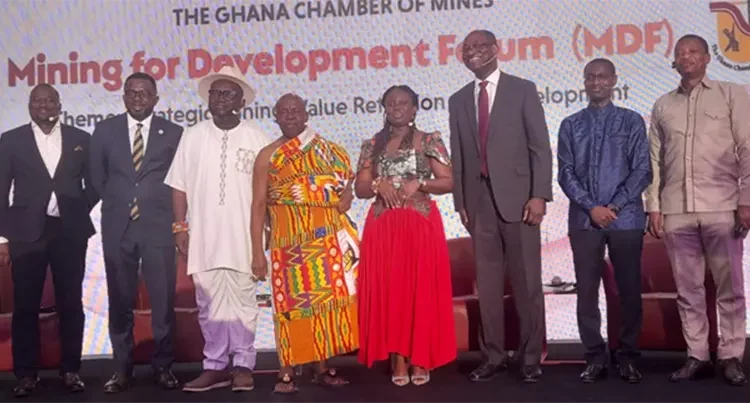
Mabel Acquaye (M) with other stakeholders in a group photograph
The absence of reliable fiscal data on Ghana’s Artisanal and Small-scale Mining (ASM) sector is undermining government efforts to assess revenue performance and formulate effective policy, policy experts have said.
Speaking at the Mining for Development Forum in Accra, Senior Programme Manager and Policy Lead for Minerals and Mining Policy at the Africa Centre for Energy Policy (ACEP), Mabel Acquaye, said attempts to obtain official figures on the sector’s contribution to national revenue have yielded nothing.
“I’ve been searching in the last six months for ASM contribution to the national fiscal contribution, and I’m not finding any document,” Acquaye said. “I have been to the Ghana Revenue Authority and even filed a Right to Information request to the Minerals Commission, but the Commission could not provide any data to show the fiscal contribution of ASM.”
Despite legal provisions for royalty payments from ASM operations, Madam Acquaye noted that the lack of accessible data persists, leaving a critical gap in revenue accountability.
She urged the Ghana Gold Board (GOLDBOD) and the Minerals Commission to prioritise ASM data collection to support the GRA in conducting accurate fiscal assessments, instead of focusing solely on traceability initiatives.
She also criticised the country’s local content policy for its narrow focus on ownership. She argued the policy should instead emphasise local manufacturing, technology transfer, and value addition.
“Many mining companies report that between 70 and 80 per cent of procurement goes to local contractors, but the real question is where those contractors source the goods. In many cases, they simply import them,” she said, citing China as an example of a country that built competitive industries through deliberate investment in skills, research, and technology.
She also called for a broader industrial policy that links mining to other sectors, promotes competitive local manufacturing, reduces the cost of doing business, and encourages investment in research and innovation.
Chief Executive Officer of the Ghana Chamber of Mines, Ken Ashigbey, acknowledged the data challenge, saying some ASM payments are collected at the local level without a centralised reporting system.
“What is happening is that some of their payments are made at the local level, and there’s no dedicated way of collecting the data,” Ashigbey said. “That data collection is important because we need to know how much is coming from the sector.”
Mr. Ashigbey said comprehensive data is essential for determining the mining sector’s overall contribution to the economy and for informing decisions on revenue allocation and development planning.
“Without the necessary data, development becomes difficult,” He added. “The policies you make are not based on complete information. It is something we all need to push so that we can get the data required to support our development.”
Mr. Ashigbey recommended collaboration between the Minerals Commission, the Ghana Revenue Authority, and the Ministry of Finance to establish a system for capturing and reporting ASM fiscal contributions nationwide.
By Ebenezer K. Amponsah