
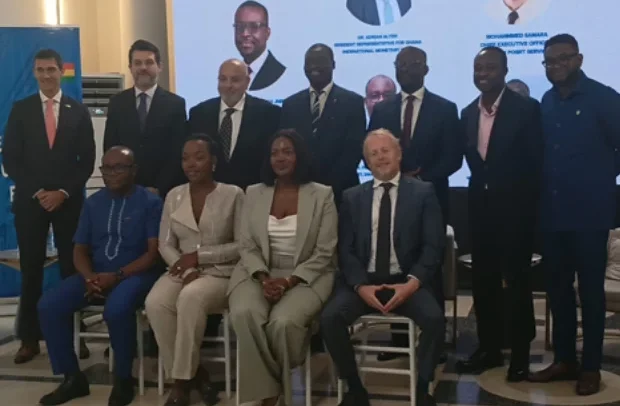
Dr. Adrian Alter with Board Members of CCIFG
The IMF Resident Representative for Ghana, Dr. Adrian Alter, has stated that although the country’s debt sustainability has improved significantly from a high risk of debt distress to a moderate risk level, Ghana must strengthen domestic revenue mobilisation to withstand future economic shocks.
Speaking at a dialogue organised by the French Chamber of Commerce and Industry in Ghana (CCIFG) on the country’s economic outlook and the IMF briefing on Ghana’s Recovery in Practice Q3-Q4 Outlook, which focused on private sector growth, energy, agribusiness and infrastructure, Dr. Alter described the upgrade in the country’s debt sustainability rating as one of the most significant but overlooked milestones achieved in recent years.
He said the improvement followed gains in key debt indicators but warned that debt service relative to exports and domestic revenue remained a concern.
“Probably the biggest milestone of the last few years is the upgrade of the debt sustainability to moderate risk of debt distress from high risk of debt distress and in distress in 2023. However, when you look at debt service to exports and debt service to revenue, we are very close, even in the baseline, which means that we need higher domestic revenues to be able to weather some of the potential shocks,” he stated.
Dr. Alter explained that although most debt indicators had improved and remained comfortably below critical thresholds, debt service obligations relative to exports and revenue remained areas of concern.
He identified the performance of State-Owned Enterprises (SOEs), public procurement, the energy sector and gold sector as some of the critical areas requiring policy attention to sustain the country’s economic recovery.
He said the recent amendments to the public procurement law provided an opportunity to improve procurement practices not only at the central government level but also among SOEs, Ministries, Departments and Agencies (MDAs), and Metropolitan, Municipal and District Assemblies (MMDAs).
Dr. Alter cited challenges in the energy sector, including issues involving the Electricity Company of Ghana (ECG), as areas requiring continued reforms.
He also noted that single-source procurement remained high, describing public procurement practices as an area requiring sustained attention.
On the IMF-supported Policy Coordination Instrument (PCI), Dr. Alter said the programme was aimed at consolidating the economic gains, strengthening institutions and building resilience.
He explained that, unlike traditional IMF financing programmes, the PCI served as a framework for monitoring and supporting government reforms.
The French Ambassador to Ghana, Diarra Dime-Labille, for her part, said Ghana’s recent economic gains should translate into increased investment and productivity.
She noted that the country had made progress in restoring fiscal credibility, controlling inflation and addressing debt vulnerabilities.
“How can we bring stability to translate into investment, productivity, productive activity in the future when we know that we are navigating a very uncertain economic situation and environment globally speaking?” she asked.
The President of the Board of Directors of the CCIFG, Guillaume Valence, also acknowledged improvements in Ghana’s economic indicators but said businesses were yet to fully experience the recovery.
He said many businesses continued to focus on managing costs and liquidity challenges rather than expanding their operations and creating jobs.
The dialogue, held in Accra, brought together players in the business community, economists, chief executives and representatives of state institutions, among others.
By Ebenezer K. Amponsah