

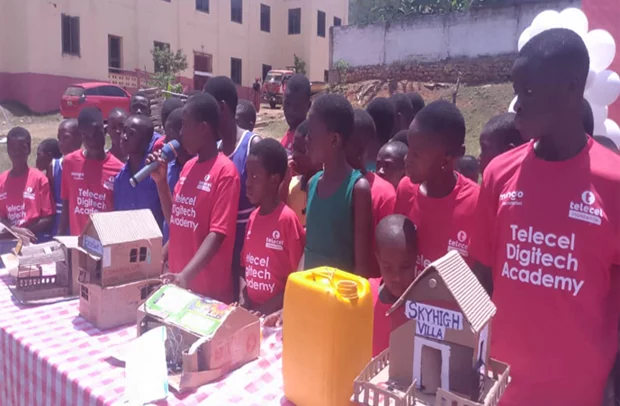
Students showcasing their projects
The Telecel Ghana Foundation has graduated over 500 students nationwide under its Digitech Academy initiative, which marks a major milestone in efforts to promote Science, Technology, Engineering and Mathematics (STEM) education among young learners.
The graduation ceremonies were held simultaneously at various locations, including Pepease Glencoe, where students showcased innovative projects developed during the programme.
The 12-week intensive training, implemented in partnership with the Mingo Foundation and supported by the Ghana Education Service, focused on equipping students with practical skills in coding, robotics and web design.
Notably, about 70 percent of participants were girls, reflecting a deliberate effort to bridge the gender gap in STEM fields.
Speaking at the event, Executive Director of Mingo Foundation, Diana Nortey, expressed excitement about the transformation observed in the students.
She noted that although some participants initially doubted their abilities, they demonstrated remarkable progress within a short period, which underscores the importance of exposure in unlocking children’s creative and innovative potential.
Ms. Nortey emphasised that the programme offers hope not only to the participating students but also to the country, as it nurtures future innovators.
She further revealed that some beneficiaries are already participating in regional and international competitions, showcasing the skills acquired through the academy.
Director of External Affairs at Telecel Ghana Foundation, Kormla Buami, reiterated the organisation’s commitment to sustained digital education.
He disclosed that over 2,000 students have benefited from the initiative over the past two years, with the latest cohort of 500 forming part of a broader national rollout.
Students at the event presented a variety of practical solutions, including automated irrigation systems and security alert technologies.
These projects, designed to address real-life challenges, demonstrated the learners’ ability to apply digital skills to solve community problems such as farming difficulties during dry seasons and theft in schools.
From Daniel K Orlando, Peki