
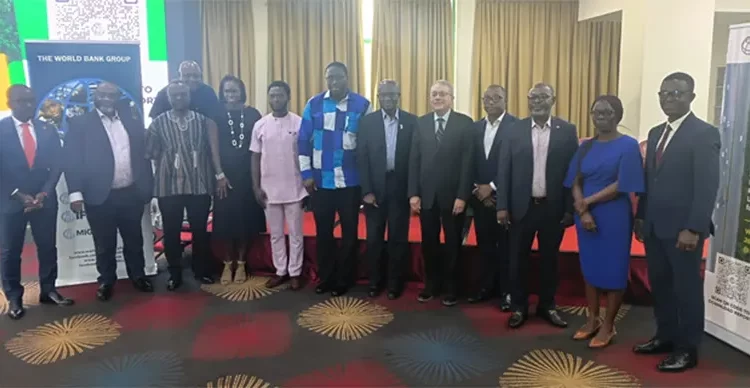
Robert Taliercio, with participants in a group photo
The World Bank has revealed that traffic injuries cost an estimated 2.1 percent of GDP annually with rural major roads showing persistent risk.
The 10th Ghana Economic Update report published for August 2026 stated that crash hotspots concentrated on 2.65 percent of urban roads and 4.37 percent of rural roads and therefore urged the government to make road safety a macroeconomic and fiscal priority.
The report launched yesterday in Accra assessed Ghana’s progress in restoring macroeconomic stability following the 2022–2023 economic crises and explores how reforms in the transport sector could support long-term growth, job creation, and economic transformation.
“Make road safety a macroeconomic and fiscal priority. Traffic injuries cost an estimated 2.1 percent of GDP annually, and crash hotspots concentrated on 2.65 percent of urban roads and 4.37 percent of rural roads, with rural major roads showing intensifying and persistent risk,” it stated.
The report titled, “Reset for Growth: Sustaining Macroeconomic Recovery and Unlocking Transport for Transformation,” indicates that road safety challenges have significant economic and development consequences, requiring urgent interventions to reduce fatalities and associated costs.
The World Bank explained that the transport sector accounts for 12.3 percent of services GDP and recorded estimated real growth of 7.5 percent in 2024 and 8.7 percent in 2025.
It, however, indicated that the sector remains under-maintained, institutionally fragmented, and poorly aligned with the needs of a growing, trade-oriented economy.
Speaking at the launch of the report, World Bank Division Director for Ghana, Liberia and Sierra Leone, Robert Taliercio, said the country’s transport sector remains a critical driver of productivity and regional integration, but persistent challenges, including inadequate maintenance financing, fragmented institutional governance, safety concerns among others continue to limit its effectiveness.
The report also highlighted that the country’s road network, covers about 94,200 kilometers, of which only 27 percent is paved, while more than half is in fair to poor condition.
It said feeder roads, which account for over 50 percent of the network, remain the most affected, with more than 60 percent classified as fair or poor.
The World Bank therefore recommended among other things a clear targets for intervention including targeted engineering, improvements on high-risk corridors, better road markings, junction redesign, pedestrian crossings, and lighting.
The measures, the report mentioned could yield significant safety returns at relatively low cost while strengthening fleet safety standards and the National Road Safety Authority’s mandate.
The report noted that while Ghana has recorded strong economic recovery indicators, including robust GDP growth, declining inflation, improved fiscal performance, strengthened external balances, and progress in debt restructuring, these gains remain vulnerable to external shocks, commodity price volatility, fiscal pressures, and structural constraints.
It stated that transport infrastructure gaps remain a major obstacle to achieving inclusive economic growth and private-sector-led job creation.
The report mentioned that although the Road Maintenance Trust Fund Act, 2025 (Act 1147), provides a framework for sustainable financing, the Road Fund currently transfers only 58 percent of road user charge collections to maintenance activities.
Beyond road safety, the report identified congestion, weak rail infrastructure, and limited access to all-weather roads as major constraints on economic development with urban congestion estimated to costs the country about GH¢4.5bn annually, equivalent to one percent of 2021 GDP.
The World Bank also recommended sustainable maintenance financing, stronger coordination across transport agencies, freight-led rail revitalisation, and expanded digital logistics systems while commending the government’s Big Push Infrastructure Programme, which committed US$2.2bn to infrastructure in the 2026 budget.
By Ebenezer K. Amponsah