
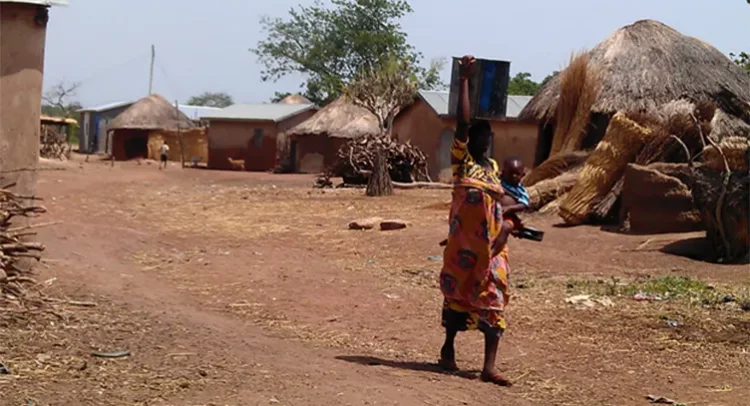
A woman in a rural community
Rural women across Africa face a double disadvantage as the urban-rural divide compounds gender gaps in education, employment, asset ownership, and access to financial and digital resources, the latest Afrobarometer Pan-Africa Profile shows.
The report, based on 50,961 interviews across 38 African countries in 2024/2025, found that women are less likely than men to attain secondary or post-secondary education and to have paid employment.
They are also less likely to own key productive, financial and digital assets, including vehicles, bank accounts, mobile-money accounts, mobile phones and computers.
In addition to these gender gaps, rural women trail urban women by even wider margins.
The findings show that when it comes to digital and financial resources, the gaps between urban women and urban men are sometimes dwarfed by those separating urban and rural women.
According to the survey, 54 percent of women have secondary or post-secondary education compared to 62 percent of men. Rural women are more than twice as likely as urban women to have no formal education – 26 percent versus 12 percent – and only about half as likely to have secondary or post-secondary qualifications, 39 percent compared to 66 percent for urban women.
In the workplace, working-age women are less likely than men to have paid employment, 25 percent versus 39 percent. Rural women lag behind urban women at 19 percent compared to 30 percent, with country-level gaps reaching up to 34 percentage points in Eswatini.
On asset ownership, women are less likely than men to own vehicles, 16 percent versus 35 percent, bank accounts, 33 percent versus 43 percent, mobile-money accounts, 56 percent versus 64 percent, mobile phones, 82 percent versus 89 percent, and computers, 16 percent versus 22 percent.
The urban-rural divide is even starker. Rural women face a 17-percentage-point disadvantage in phone ownership, 73 percent versus 90 percent for urban women.
They are half as likely to have a bank account, 21 percent versus 42 percent, and less than one-third as likely to own a computer, 7 percent versus 24 percent.
Women are also less likely than men to make their own decisions about financial resources, 36 percent versus 44 percent, and are about twice as likely to say their spouses decide. Rural women are on average 11 percentage points less likely than urban women to say they make financial decisions themselves.
The report, however, points to a notable exception in political participation. While women participate at lower rates than men overall, rural women outpace their urban counterparts in several forms of engagement, including voting and political party affiliation, suggesting opportunities to strengthen women’s voice and representation in rural communities.
A Daily Guide Report