
The Writer
Akua owns a business that supplies fresh produce and foodstuff to supermarkets across Accra. Aside from buying her produce from local farmers, she also imports apples, avocados, and pears from farmers in the Netherlands and Côte d’Ivoire. The business is a success. Akua employs several people, including two drivers. Her secret is the mass refrigerator she keeps onsite.
At the end of February 2020, Akua travelled to the Netherlands to meet with importers interested in buying pineapples and mangoes from Ghanaian farmers. She also placed orders for avocadoes from her Ivorian farmers.
Then the COVID-19 pandemic hit. Travel bans, entry restrictions, quarantine and testing requirements meant she could not meet with business partners – shipping produce was temporarily put on hold.
Even food sourced from Côte d’Ivoire would take an unusually long time to enter the country. Time a perishable goods business like hers did not have.
As months passed, Akua was forced to let some of her staff go. She was unable to pay them, as eventually the business had to be shut down. Akua’s story is no exception. Across the world, the same story was unfolding.
EU response to COVID-19
The COVID-19 pandemic not only disrupted global infrastructure, it also unearthed vulnerabilities in global supply chains, health systems, and international partnerships.
These systems are not only critical to entrepreneurs like Akua, but also to the average Ghanaian buying food or medicine across the road, and the EU-Ghana trade more broadly.
COVID-19 revealed shortages and lack of access to medical goods such as vaccines and Personal Protective Equipment (PPEs), and dismantled digital connections and networks, deeply impacting economies and in turn, people.
The Global Gateway Strategy is the European Union’s response to global challenges, like the COVID pandemic, driven by a profound belief that only reliable partnerships, without threats or tariffs, help to move Europe and Africa forward.
What is Global Gateway?
Global Gateway is the EU’s investment strategy to boost smart, clean and secure networks in digital, energy and transport sectors, and to strengthen health, education and research systems across the world.
Adopted on 1 December 2021, Global Gateway mobilises up to EUR 150 billion in investments for Africa geared towards building sustainable global infrastructure. It is Europe’s best offer, available to close partners only—like Ghana.
Global Gateway covers hundreds of sustainable and quality investment projects developed and supported by the EU and its Member States. The Strategy combines large-scale infrastructure projects with investments in regulatory standards, technology transfer, and know-how. It is implemented by the collective firepower of Team Europe mobilising all EU institutions, Member States, their Development Finance Institutions, the European Investment Bank (EIB), and the European private sector.
The private sector brings in investment and knowledge while developing skills in partner countries. The funding for Global Gateway projects come in different forms: loans for big infrastructure, grants for high-impact community projects and green bonds for climate and energy initiatives.
From 2021 to 2027, Global Gateway invested almost EUR 1 billion in infrastructure investments in Ghana. Global Gateway is no form of charity, or aimed to create new dependencies, but rather combines the priorities of partner countries with the EU’s own interests. Global Gateway is about building high-quality infrastructure, like safe transport, better digital connections and renewable energy projects, while prioritising people like Akua.
In Ghana, a core focus of the Global Gateway Strategy is health innovation. During the pandemic, Ghana made a call to global partners to support its goal of becoming a regional vaccine manufacturing hub.
The European Union was the first to respond by first delivering 2.4million doses of CoVID-19 vaccines and PPEs to Ghana, making Ghana the first country to receive coronavirus vaccines through the UN-backed COVAX Facility. Six years on, we have doubled down on that support.
Moving past emergency response, Global Gateway helps to realise Ghana’s goal of becoming a local vaccine manufacturing hub on the continent through the Team Europe Initiative (TEI) Manufacturing and Access to Vaccines, medicines & health technology products in Africa (MAV+). Under MAV+, Ghana receives nearly EUR 40 million to support its emergence as a regional local vaccine manufacturing hub.
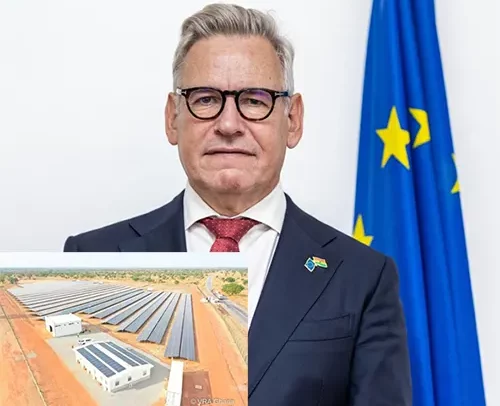
Renewable energy is also part of the mix, with the Kaleo I and Kaleo II solar power plants located in the Nadowli-Kaleo District of Ghana’s Upper West Region, which generate 13MW and 15MW respectively.
Under Global Gateway, the EU works to enhance agricultural value addition, by strengthening value chains, strengthening climate-resilience, and creating sustainable food chains. Projects like Better Farming in Northern Ghana, a EUR 19.5million EU investment, led by the Ministry of Food and Agriculture, advances climate-smart agroforestry, landscape restoration, and women’s economic empowerment.
Infrastructure-wise, the Abidjan-Lagos Corridor Highway is an example of Global Gateway supporting the facilitation of trade and regional integration. The 1,028km six-lane, dual-carriage highway will link Abidjan, Accra, Lomé, Cotonou, and Lagos, and interlink with the larger Dakar-Lagos corridor, helping Ghana and its neighbouring countries to boost trade and economic exchanges.
Global Gateway’s success is dependent on its connection to all its priorities.
Under Global Gateway, Akua’s business, and millions of others across the world, have a chance to not only survive disruptions, but to grow and innovate.
From easier access to vaccine and medicines, diversified and green power supply and the transition to a greener, more climate-resilient agriculture and sustainable value-chain system, Global Gateway makes it possible for countries and people to withstand the impact of another pandemic.
At its very heart, Global Gateway aims to meet the many interests the EU shares with all the Akuas of the world.
By: Rune Skinnebach, EU Ambassador to Ghana