

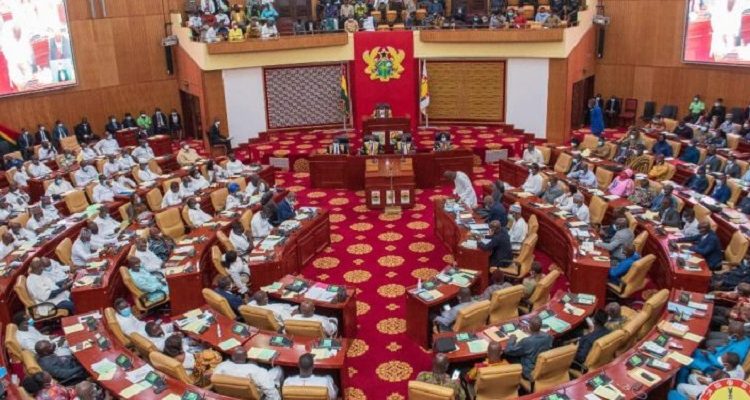
The World Bank has reaffirmed its commitment to strengthening Ghana’s Parliament through targeted capacity-building programmes aimed at enhancing legislative oversight and governance.
Speaking at an engagement with the leadership of Parliament, Managing Director and Chief Knowledge Officer, Paschal Donohoe, announced that the Bank, in collaboration with the United Kingdom’s Foreign, Commonwealth and Development Office (FCDO), has secured funding support to build the capacity of five key parliamentary committees.
According to him, the initiative underscores the World Bank’s recognition of Parliament as a critical institution in shaping sound public policy and ensuring effective governance.
Drawing from his own experience as a former parliamentarian in Ireland, Mr. Donohoe, who led a delegation from the Bank for a visit to the House, noted that strengthening Parliament ultimately improves government performance and policy outcomes.
“We place great value on our relationship with Parliament and the need to engage not only with government but with Parliament itself,” he stated, adding that a stronger legislature contributes positively to national development.
He explained that the Bank’s broader mission in Ghana remains focused on job creation and expanding economic opportunities, particularly for the youth.
He cited recent visits to educational institutions, including the University of Ghana, where he observed the entrepreneurial potential of young people, stressing the need to create an enabling environment for them to thrive.
The Minority Leader, Alexander Afenyo-Markin, however, called for a more inclusive approach to the programme.
He emphasised the need for equitable distribution of capacity-building opportunities between Majority and Minority members, warning that existing allocation structures could disadvantage the Minority, which plays a crucial oversight role.
He further urged the World Bank to expand the scope of the programme to include more parliamentary committees and technical staff, noting that staff members are key custodians of institutional memory and essential to sustaining legislative effectiveness.
The Minority Leader also advocated deeper technical support for the Public Accounts Committee to strengthen its review of audit reports and budget implementation.
While acknowledging signs of macroeconomic stability, the Minority Leader cautioned that the real test of economic recovery lies in its impact on ordinary citizens.
“The metrics of recovery must translate into the lived realities of our people,” he said, stressing Parliament’s responsibility to ensure that economic gains are felt across communities.
On his part, the Majority Leader, Mahama Ayariga, welcomed the World Bank’s intervention and called for exposure to international best practices to enhance the work of parliamentary committees.
He also appealed for an increase in funding support, revealing that Parliament continues to face budgetary constraints that limit its ability to fully implement capacity-building initiatives.
He noted that despite improvements in key economic indicators, including relative currency stability and fiscal discipline, resource limitations remain a challenge for the legislature.
By Ernest Kofi Adu, Parliament House