
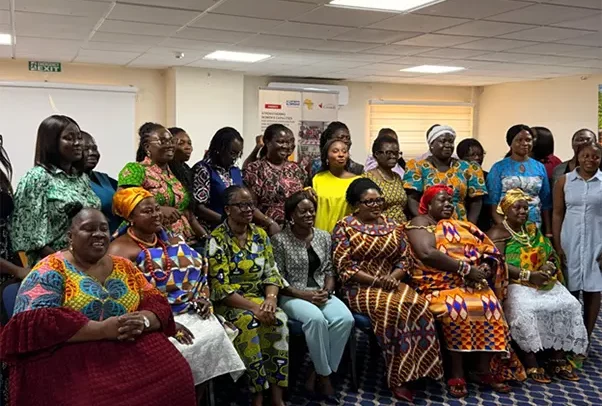
A group photograph of dignitaries at the launch
Gender advocacy group, ABANTU for Development, has announced plans to empower 30 women to contest the 2027 District Assembly Elections as part of a new two-year project aimed at closing Ghana’s local governance gender gap.
The project, with support from Plan International Ghana, titled, “Strengthening Women’s Capacities for Effective Participation and Representation in Ghana’s Local Governance System,” will be implemented from April 2026 to March 2028 across three municipalities: West Akim Municipal in the Eastern Region, Adansi Asokwa District in the Ashanti Region, and Ledzokuku-Krowor Municipal in the Greater Accra Region.
Executive Director of ABANTU for Development, Rose Mensah-Kutin, said it would pursue two central objectives: First, strengthen the capacities of 30 prospective women candidates, including young women and women with disabilities, to run effective campaigns; Second, drive advocacy and public awareness for the effective implementation of the Affirmative Action (Gender Equity) Act, 2024.
“As part of the effort, the organisation will engage duty bearers, particularly the Ministry of Gender, Children and Social Protection and the Ministry of Local Government and Rural Development, to push for increased participation and representation of women in local governance structures.
“The under-representation of women in local governance is not a women’s problem alone; it is a democratic deficit that concerns us all,” she stated.
Madam Mensah-Kutin called on government institutions, district assemblies, political parties, traditional and religious authorities, the media, civil society organisations, and citizens to join in dismantling barriers that keep women out of decision-making.
“The 30 percent threshold is the baseline of a fair and inclusive democracy. As Ghana looks toward the 2027 District Assembly Elections, let us work together to make certain that women are not only on the ballot, but in the rooms where decisions are made, in keeping with the central and transformative promise of leaving no one behind,” she added.
The Minister for Gender, Children and Social Protection, Dr. Agnes Naa Momo Lartey, pledged continuous efforts to champion policies, programmes and legal reforms aimed at promoting gender equality and increasing women’s participation and leadership in governance.
A major milestone in this regard is the passage of the Affirmative Action Act, which represents a historic achievement in Ghana’s pursuit of gender equality and inclusive governance.
“I am pleased to inform you that since the passage of the Act, the Ministry has undertaken several measures to facilitate its implementation. These include the establishment of a Gender Equity Committee to guide and oversee implementation processes, the development and submission of the Legislative Instrument to Parliament, nationwide stakeholder sensitisation and awareness creation programmes, and the establishment of a functional secretariat to support implementation effort,” she disclosed.
The minister further stated that the implementation of the National Gender Policy 2025–2034, which remains Ghana’s principal policy framework for promoting gender equality and women’s empowerment, is underway.
BY Prince Fiifi Yorke