
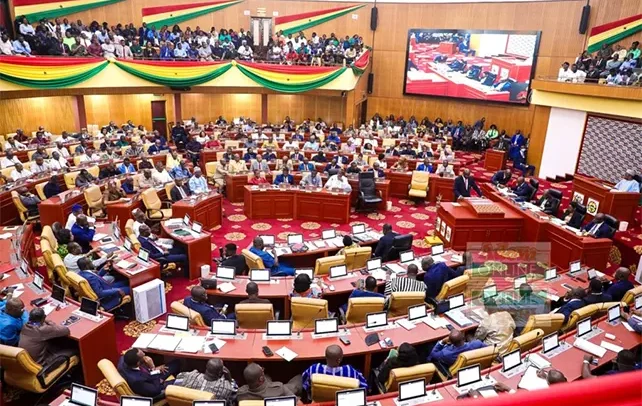
Parliament has passed the Maritime and Related Offences Bill, 2026, which establishes the country’s first comprehensive legal framework to combat piracy, armed robbery at sea and other maritime crimes in a move aimed at strengthening security in the country’s territorial waters and the Gulf of Guinea.
The legislation, which was introduced by the Minister for Transport, Joseph Nikpe Bukari, seeks to enhance the prevention, investigation, prosecution and punishment of maritime-related offences while bringing the country’s domestic laws in line with international maritime conventions.
The Bill was referred to Parliament’s Committee on Roads and Transportation after its introduction on March 10, 2026. The committee, after consultations with the Ministry of Transport, the Ghana Maritime Authority, the Office of the Attorney-General and other stakeholders, recommended its passage.
According to the committee’s report, the new law responds to the growing threat of piracy, vessel hijackings, kidnapping of crew members for ransom, armed robbery at sea and the destruction of maritime property in the Gulf of Guinea over the past decade.
It noted that the increasing frequency and sophistication of maritime crimes have posed significant risks to maritime trade, regional stability, economic development and the safety of seafarers operating within the region.
During consideration, MPs observed that the nation’s previous legal framework lacked dedicated provisions to effectively investigate and prosecute piracy and related maritime offences, creating enforcement challenges for security agencies.
They said the enactment of the law would provide the legal basis for the arrest, investigation, prosecution and punishment of offenders while ensuring Ghana fulfils its obligations under the United Nations Convention on the Law of the Sea, 1982, and the International Convention for the Suppression of Unlawful Acts against the Safety of Maritime Navigation, 1988.
The 24-clause legislation outlines the scope of the law, the responsibilities of the Ghana Maritime Authority and the jurisdiction of the High Court over offences committed under the Act.
It also provides for the seizure of vessels, arrest of suspects, extradition of offenders, notification to state parties and reporting obligations to the International Maritime Organisation (IMO).
Parliament’s Roads and Transportation Committee described the legislation as critical to the nation’s ambition of becoming a leading maritime hub in the Gulf of Guinea.
According to the committee, the law will strengthen trade security, reinforce state port control, improve investor confidence and empower security agencies to act decisively against maritime criminals while protecting the livelihoods of seafarers.
The committee, however, stressed that the success of the legislation would depend on effective implementation.
It urged the government to commit adequate financial and logistical resources to the Ghana Maritime Authority and other enforcement agencies to ensure the law is fully operationalised.
The committee recommended continuous training for personnel, the acquisition of modern surveillance equipment and stronger collaboration among the Ghana Maritime Authority, the Ghana Navy, the Marine Police, the Attorney-General’s Department and other relevant institutions.
A fiscal impact assessment accompanying the Bill indicated that implementation would have minimal financial implications for the state since existing institutions would enforce the law.
The report estimated an additional recurrent expenditure of about GH¢215,787.76 annually for the servicing, maintenance and fueling of patrol vessels, while stakeholder sensitisation, inter-agency coordination and training activities would cost an estimated GH¢50,000 a year.
It added that fines imposed following successful prosecutions could generate additional revenue for the state, making the legislation fiscally sustainable while significantly strengthening Ghana’s maritime security regime.
By Ernest Kofi Adu, Parliament House