
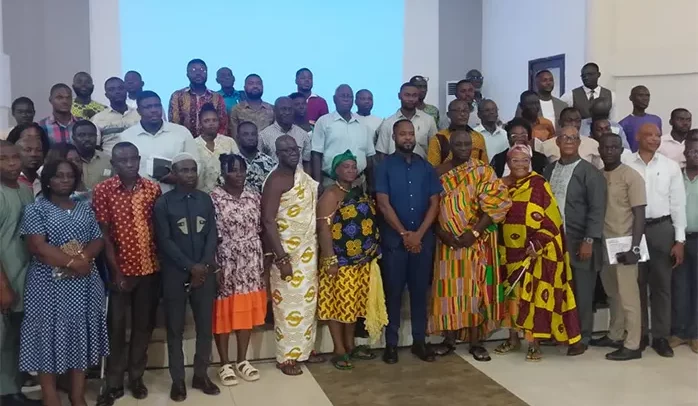
Some of the participants
The Sekondi-Takoradi chapter of CoST Infrastructure Transparency Initiative has unveiled a report that assessed infrastructure data publication and disclosure performance by the 14 Metropolitan, Municipal and District Assemblies (MMDAs) in the Western Region.
CoST Infrastructure Transparency Initiative is a global multi-stakeholder initiative that promotes transparency, accountability and value for money in public infrastructure.
The report is the outcome of five months of data collection, analysis, validation, and field verification covering 28 infrastructure projects across the region.
It also assessed the infrastructure quality, climate resilience, and integrity in infrastructure planning across the projects lifecycle.
The move was aimed at strengthening transparency, accountability, and public value in the infrastructure sector in the Western Region.
This came to light at the launch and Dissertation of the 3rd CoST Independent Infrastructure Review Report.
The Sekondi-Takoradi Multi-Stakeholder Group Chairman of CoST, Eugene Ofori-Atta, noted that the launch has set the stage for an honest, constructive, and forward-looking conversation.
“The report is the outcome of five months of data collection, analysis, validation, and field verification covering twenty-eight infrastructure projects across the region,” he added.
He said, “It is a reaffirmation of our region’s commitment to building an infrastructure sector that is transparent, participatory, accountable, and driven by evidence.”
He indicated that across the world, transparent infrastructure delivery has become a cornerstone of economic resilience and public trust.
“And here in the Western Region, we are steadily positioning ourselves as a leader in Ghana,” he pointed out.
Aziz Mahmoud, CoST Monitoring, Evaluation, Accountability, and Learning (MEAL) Officer, disclosed that the review applied the CoST Infrastructure Data Standard (IDS), the ACTS Framework, and the Framework for Integrity in Infrastructure Planning (FIIP) to identify governance gaps, integrity risks, and opportunities for improving transparency, accountability, sustainability, and value for money in public infrastructure delivery.
Matthew Kwaw Somiah, the Team Lead, mentioned that other objective of the review was to provide recommendations for stronger transparency and infrastructure delivery.
From Emmanuel Opoku, Takoradi