
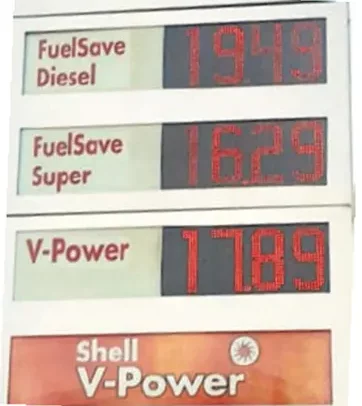
Motorists across the country have been hit by another round of fuel price increases, with some Oil Marketing Companies (OMCs) raising pump prices to their highest levels in recent months, pushing petrol to as high as GH¢16.29 per litre and diesel to GH¢19.49 per litre.
The latest upward adjustment, which took effect under the industry’s bi-weekly fuel price review mechanism, follows a sustained rise in global crude oil prices, increases in refined petroleum product prices and the recent depreciation of the Ghana cedi against the US dollar.
Among the major OMCs, Shell is now selling petrol at GH¢16.29 per litre and diesel at GH¢19.49, while GOIL has revised its prices to GH¢15.99 for petrol and GH¢19.26 for diesel.
Earlier, Star Oil, one of the country’s largest fuel retailers, led the latest round of price adjustments on August 1, 2026, increasing petrol from GH¢14.47 to GH¢14.53 per litre and diesel from GH¢17.67 to GH¢18.97.
The company’s petrol price matched the minimum price floor set by the National Petroleum Authority (NPA).
The latest review marks the third upward adjustment by Star Oil since July 15, 2026, reflecting the persistent rise in international petroleum prices.
The Chief Executive Officer (CEO) of Star Oil, Philip Tieku, explained in a Facebook post on July 24 that international market conditions had made further increases unavoidable.
According to him, world market prices of gasoline have increased by nearly 20 per cent, while diesel prices have risen by approximately 25 per cent since the current pricing window began.
He added that the depreciation of the Ghana cedi against the US dollar had further increased the cost of importing petroleum products.
Mr. Tieku explained that many OMCs had begun adjusting prices even before the official August pricing window because most companies purchase fuel on a daily cash-and-carry basis, meaning every new consignment reflects prevailing international prices and exchange rates.
Industry sources indicate that additional OMCs are expected to adjust their pump prices, with some implementing new prices on August 2, while others delayed their reviews until yesterday, August 3.
Although earlier industry projections suggested petrol could sell for around GH¢15.23 per litre and diesel above GH¢17.45, the latest prices announced by some major retailers have exceeded those forecasts.
The latest fuel price hikes are expected to intensify pressure on the Ghana Private Road Transport Union (GPRTU) to demand higher transport fares, with operators arguing that increasing fuel costs have significantly raised operating expenses.
According to the Chamber of Oil Marketing Companies (COMAC), the current price increases are being driven primarily by soaring international crude oil prices and higher prices for refined petroleum products.
COMAC said average crude oil prices rose by 23.25 per cent during the review period, while refined petroleum products also recorded substantial increases. Diesel posted the highest increase of 24.84 per cent, followed by petrol at 12.58 per cent and liquefied petroleum gas (LPG) at 12.24 per cent.
The Chamber noted that average crude oil prices climbed from US$71.90 to US$88.62 per barrel over the review period.
It attributed the surge to heightened geopolitical tensions, particularly developments surrounding the United States-Iran conflict and uncertainty over the reopening of the Strait of Hormuz, one of the world’s most important oil shipping routes.
COMAC explained that although initial optimism over a possible peace agreement briefly eased prices, Iran’s rejection of Oman’s shared-control proposal, renewed tanker attacks and continued shipping restrictions have sustained global supply concerns, keeping Brent crude close to US$88 per barrel.
The Chamber also cited the cedi’s depreciation as another major contributor to higher pump prices.
For the August 1 pricing window, the exchange rate weakened from GH¢11.4970 to GH¢11.6593 to the US dollar, representing a 1.41 per cent depreciation and increasing the cost of importing petroleum products.
Government Intervention
Meanwhile, the government has announced a temporary intervention to cushion consumers from the latest increases.
In a statement signed by the Minister for Government Communications and Presidential Spokesperson, Felix Kwakye Ofosu, President John Dramani Mahama directed that the regulatory margin on diesel be reduced by GH¢2.00 per litre for one month.
The directive, which takes effect from today, August 4, 2026, is intended to cushion consumers, prevent transport fare increases, contain inflationary pressures and reduce the impact of higher fuel prices on the cost of living.
The statement said the intervention follows a Cabinet decision and builds on a similar measure implemented in April this year.
Government said it would continue to monitor developments in the international energy market and introduce additional policy measures where necessary, to protect consumers and sustain the country’s economic recovery.
By Ernest Kofi Adu