
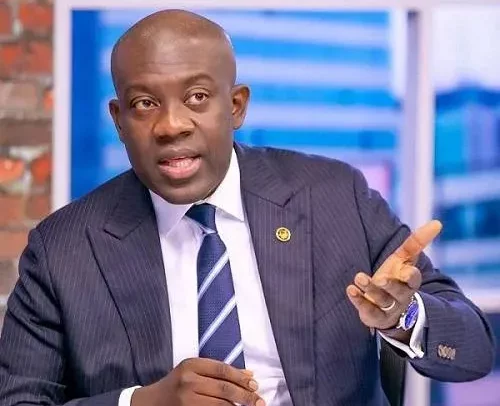
Kojo Oppong Nkrumah
The Supreme Court (SC) will today decide whether or not to restrain two High Courts from proceeding with the trials of some former appointees of the New Patriotic Party (NPP) during the legal vacation, pending the determination of a substantive suit challenging the constitutionality of the Chief Justice issuing the court warrants to continue the trials.
Member of Parliament (MP) for Ofoase-Ayirebi, Kojo Oppong Nkrumah, has filed a suit at the Supreme Court challenging the constitutionality of the Chief Justice’s warrant permitting certain courts to continue the hearing of selected criminal cases during the legal vacation.
He avers that the Chief Justice’s directive for the judges to continue hearing some selected cases during the legal vacation is unconstitutional and inconsistent with the spirit of Articles 17(1), (2) and 296(a) and (b) of the 1992 Constitution.
He also contends that the Chief Justice’s action to promote and facilitate the hearing of ‘special criminal cases’ in the legal vacation to the neglect of other criminal cases amount to selective justice, which contravenes Article 17(1) of the Constitution and therefore unconstitutional, null and void.
According to him, the impugned warrant confers preferential treatment upon selected criminal cases during the legal vacation without objective and constitutionally ascertainable criteria regulating that selection.
He followed it up with an application for interlocutory injunction seeking to restrain the trial judges from proceeding with the trials pending the determination of the writ.
He argues that unless the implementation of the impugned warrants is restrained pending the determination of the substantive action, the very subject matter of the action will continue to be acted upon while its constitutional validity remains undetermined.
The affidavit in support of the application further points out that the criminal trials may involve the taking of evidence from witnesses, the admission of documentary and other evidence, cross-examination, rulings on applications, legal submissions and other substantive judicial steps.
“Some of the criminal proceedings being conducted pursuant to the impugned warrants will progress substantially and even conclude before the substantive constitutional action is finally determined.”
Moving the motion yesterday, his lawyer, Frank Davies, argued that the continuation of the impugned court sittings risks rendering the substantive reliefs sought nugatory and a final declaration by the apex court will be deprived of practical effect in relation to proceedings already conducted pursuant to the impugned warrants.
He said if the impugned warrants are ultimately declared unconstitutional, it may be difficult or impracticable to restore the parties in those criminal proceedings to the precise position in which they would have been had the warrants not been implemented.
Mr. Davies further argued that the balance of convenience favours the preservation of the status quo pending the determination of the substantive constitutional questions since the trials can resume if the case is unsuccessful.
He added that if the injunction is refused and the suit ultimately succeeds, irreparable harm would occasion the accused persons which cannot be remedied by monetary compensation.
Opposition
The application was opposed by Deputy Attorney General, Dr. Justice Srem-Sai, who argued that it did not meet any of the three grounds set for the grant of an interlocutory application.
He contended the application is based on a misunderstanding between the administrative function of the Chief Justice to issue a warrant and the judicial function of a trial judge to conduct his or her trials in court.
He pointed out that if a party is aggrieved with the decision of the trial court, the remedy is not an original motion evoking the original jurisdiction of the Supreme Court but a motion for certiorari.
Dr. Srem-Sai further argued that the applicant failed to show that irreparable harm would be done him if the interlocutory injunction is refused, as he is not one of the accused persons standing trial before the High Courts.
The court, presided over by a single judge, Justice Gabriel Pwamang, after listening to both sides, adjourned the case to today, August 21, for a ruling.
BY Gibril Abdul Razak