
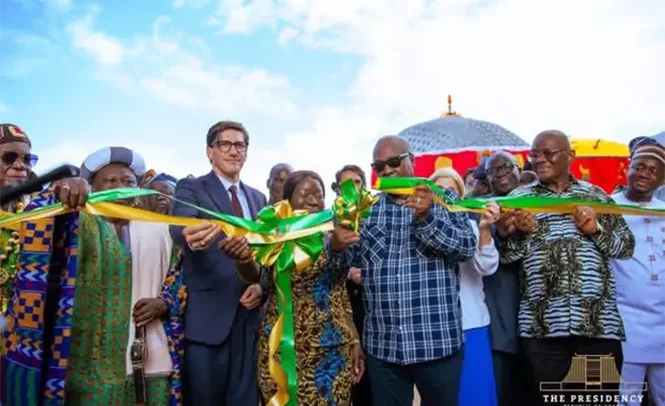
President John Dramani Mahama commissioning Northshore Apparel
President John Dramani Mahama has commissioned Northshore Apparel Ghana Limited in Savelugu in the Northern Region, describing the garment factory as a major step towards restoring the region’s industrial fortunes.
The factory, established under the government’s 24-Hour Economy programme, is expected to create more than 10,000 jobs for young people when it reaches full production capacity.
At the commissioning ceremony, President Mahama said the establishment of Northshore would help revive the Northern Region’s industrial past and create sustainable employment opportunities for the youth.
“Today we have planted a seed that will return the North to its glorious industrial past, and that’s what Northshore is about,” he said.
He said the government was committed to supporting businesses capable of creating jobs and contributing to economic transformation.
President Mahama noted that the factory would operate several shifts, creating employment opportunities while reducing the migration of young people from the north to the south.
He said about 80 percent of the factory’s employees were young women, many of whom had previously travelled to southern part of the country in search of menial jobs.
Nurideen Mohammed, Chief Executive Officer of Northshore Apparel Ghana, said the project would be developed in three phases.
He said the first phase comprised the garment manufacturing facility, while the second phase would double sewing capacity to 200 lines, add two sewing production facilities, expand cutting and design capacity, and install 1.5 megawatts of solar power with battery storage.
The third phase, he said, would involve the establishment of a fabric mill and a cotton outgrower scheme across the sub-region, with the ultimate aim of exporting finished garments rather than raw cotton.
Phase One comprises 50 sewing lines on a 40,000-square-metre facility located on a 50-acre campus. It also includes a cutting and design facility, two warehouses, dining facilities, administration offices, locker rooms, solar power, a bio-digester, a 600,000-litre underground water reservoir, mechanised boreholes, a clinic, crèche and place of worship.
Mr. Mohammed said the company had trained and deployed more than 2,300 operators at the factory.
He said locating the factory in Savelugu would help reduce unemployment and discourage young people from migrating to major cities in search of scarce jobs.
He also highlighted the company’s commitment to inclusion, saying it had employed 40 people with hearing impairments and intended to expand opportunities for persons with disabilities.
Chief Executive Officer of the Ghana Export-Import Bank, Sylvester Mensah, said the project represented a new chapter of opportunity for northern Ghana.
He said the government’s investment in garment and apparel manufacturing formed a key part of its five-year economic transformation plan.
Mr. Mensah said the factory would create direct employment while generating opportunities in transportation, food services and export-related activities.
Presidential Advisor on the 24-Hour Economy Programme, Goosie Tanoh, commended Northshore’s management and workers, saying the project demonstrated confidence in the potential of northern Ghana.
He said the factory would enable young people to build their lives in the north instead of migrating southwards or travelling abroad in search of opportunities.
FROM Eric Kombat, Savelugu