
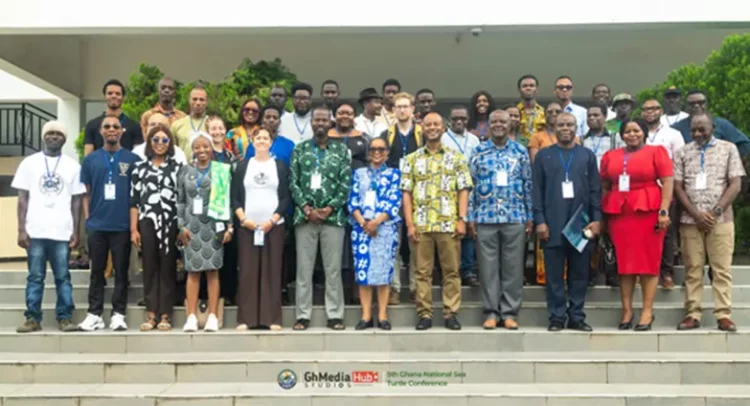
Dr. Andrews Agyekumhene (m) with stakeholders in a group photo
Stakeholders in sea turtle conservation have been urged to shift from viewing coastal communities as mere beneficiaries of conservation programmes and rather recognise them as active partners in protecting marine ecosystems.
Speaking at the 5th Ghana National Sea Turtle Conference (GNSTC) 2026 in Accra, the Executive Director of Wildlife and Human Resources Organisation WHRO Ghana, Dr. Andrews Agyekumhene, said conservation efforts could only achieve lasting impact when local communities were fully involved in decision-making and monitoring processes.
“Community stewardship means moving beyond conservation for communities to conservation with communities. It means recognising coastal communities not simply as beneficiaries or people who need to be educated, but as partners, custodians and active participants in conservation,” he stated.
Dr. Agyekumhene, who is also a Senior Lecturer at the Department of Marine and Fisheries Sciences of the University of Ghana, said the long-term survival of sea turtles depended largely on what happened in areas where turtles nested, fishing activities took place, coastal development occurred and communities interacted with the species daily.
He said for decades conservation efforts have demonstrated that science, monitoring, legislation and enforcement are essential.
The Executive Director also explained that empowering communities to understand the value of sea turtles, participate in monitoring and decision-making, and benefit from conservation initiatives would create a foundation for sustainable stewardship beyond individual projects and funding cycles.
Dr. Agyekumhene noted that when communities are empowered to understand the value of sea turtles, participate in monitoring and decision-making, and see tangible benefits from conservation, possibilities of stewardship could continue after individual projects and funding cycles have ended.
He, however, noted that significant challenges continued to threaten sea turtle conservation efforts, including coastal development, light pollution, human activities, climate change and other emerging threats.
Dr. Agyekumhene stressed the need for stronger collaboration between scientific researchers, conservation practitioners and local communities to address the challenges confronting sea turtle conservation.
“We need stronger collaboration between science and practice. We need better integration of local knowledge and scientific knowledge. We need to strengthen community involvement. We need to invest in young people. We need to make better use of volunteers. And we need to build partnerships that can sustain conservation beyond the lifespan of individual projects,” he stated.
He further urged participants at the conference use the platform as an opportunity to develop new approaches and strengthen partnerships aimed at protecting sea turtles in Ghana.
The Ghana National Sea Turtle Conference, which began in 2018, was established as a platform for researchers, conservation organisations, government institutions, community members, students, volunteers and other stakeholders to share knowledge, experiences, challenges and solutions relating to sea turtle conservation in the country.
A Daily Guide Report