
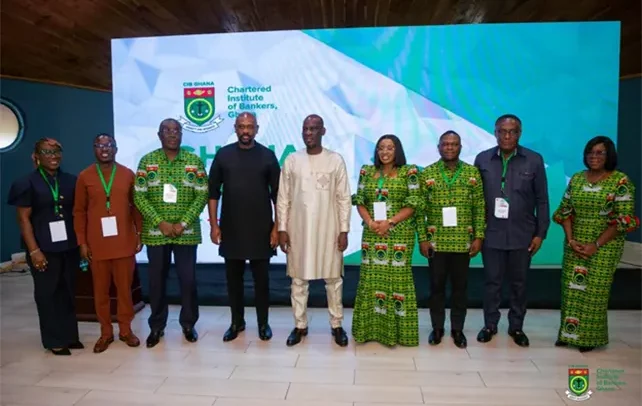
Stakeholders present at the 30th Banking and Ethics Conference
The Chartered Institute of Bankers, Ghana (CIB Ghana), has called for stronger professional and ethical standards across the banking industry as artificial intelligence (AI), virtual assets and tokenisation reshape financial services.
The call was made at the conclusion of the Ghana Banking Conference 2026, the Institute’s 30th National Banking and Ethics Conference, held from November 9 to 10 at Aqua Safari Resort in Ada.
Themed “Banking on the Future: Trust, Technology and Transformation”, the conference brought together chief executives of banks, board chairs, regulators, policymakers and other industry professionals.
It was the first time the conference had been held outside Accra in its 30-year history.
The Minister of Education, Haruna Iddrisu, who formally opened the conference, invited the Institute to submit proposals for reviewing the legal framework governing the banking profession.
He pledged to convey the recommendations to the Minister of Finance for consideration.
“How does our banking legislation strengthen trust? How does our banking legislation make ethical use of technology? And how does our banking technology progressively respond to the needs of the people? Get your team to look at it properly so that as I leave here, I will have a policy blueprint informed by your professional input,” Mr. Iddrisu said.
He also advocated the integration of financial literacy into foundational education, describing loan default as a breach of trust.
“My first recommendation is for you to advise the government, and we’re happy to do so, to integrate financial literacy into basic foundational learning. Default, in my view, means betrayal of trust,” he said.
The President of CIB Ghana, Dr. Ellen Ohene-Afoakwa, FCIB, reaffirmed the Institute’s commitment to raising professional standards, strengthening research and deepening its influence on banking policy.
“We will significantly raise the bar on professionalism, ethics, research and policy influence within the banking industry,” she said.
She identified fraud, cyber threats and unethical conduct as major challenges requiring collective industry action, while highlighting plans to upgrade the Institute’s digital and physical infrastructure, including its proposed Bankers’ House.
“Our collective fight against fraud, cyber threats and unethical behaviour is key to building public trust in the banking system and the economy,” she said.
“Upgrading our digital and physical infrastructure, what we call the Bankers’ House, so CIB Ghana can serve the modern profession in a modern way, will also be key,” she added.
Dr. Ohene-Afoakwa further stressed that the banking industry must remain anchored in values and public confidence, despite technological advancements.
“In the end, banking is not just about systems. It is about the values that guide our decisions, the trust we earn from the public every single day,” she said.
The Governor of the Bank of Ghana, Dr. Johnson Pandit Asiama, commended the Institute for sustaining the conference over three decades.
In an address delivered on his behalf by the BoG Director of Communications, Bernard Otabil, Governor Asiama stressed that technological innovation must complement, rather than undermine, the principles underpinning a stable banking system.
“Innovation should advance the interests of customers and the economy, but it must not weaken the principles of integrity, accountability, and financial stability,” he said.
“The most effective safeguard is an industry culture in which ethical conduct is embedded in decision-making and consistently upheld, not merely observed when regulators are present,” he added.
A Business Desk Report