
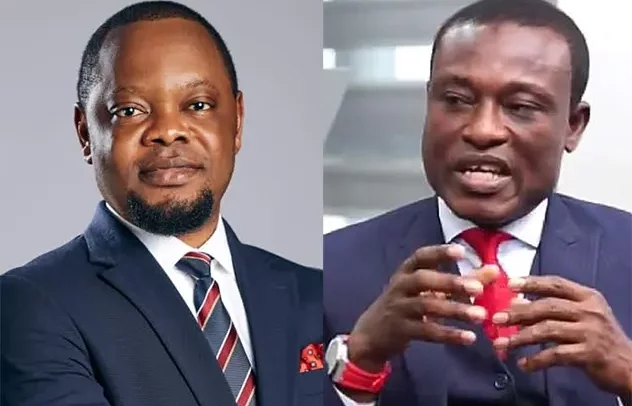
Dr. Justice Srem-Sai and Kissi Agyebeng
The rift between the Office of the Attorney General (AG) and the Office of the Special Prosecutor (OSP) appears to be widening, with the two law enforcement agencies ostensibly engaging in some sort of power play.
While the heads of the two institutions publicly claim there is no apparent issues between them, recent happenings however, paint an entirely different scenario.
The latest development suggesting a tussle between the two entities is portrayed in comments made by the Director of Strategy, Research and Communications at the OSP, Sammy Darko and Deputy Attorney General, Dr. Justice Srem-Sai on allegations of non-collaborations between the two offices.
Sammy Darko, speaking on Joy FM’s News File programme, indicated that the Office of the Attorney General has declined several requests from the OSP to collaborate on cases.
According to him, the OSP had approached the AG’s office on multiple occasions for collaborations on national issues but did not receive any support from the office.
“There are so many issues the OSP has kept quiet and not talked about. Look, there are instances where the OSP has approached the Attorney General’s office and said, let us collaborate in this matter and we have been turned down,” he claimed.
Although he pointed out that the OSP maintains a generally good relationship the Office of the Attorney General and other state institutions, he said there were times that their request for case-specific collaborations were turned down.
Mr. Darko further noted that several developments occur behind the scenes, but was quick to point out that “when you are managing a state institution, a very sensitive one, it is not all the information you will come out to the public to talk about.”
DAG Fires Back
The Deputy Attorney General, Dr. Justice Srem-Sai, in sharp rebuttal refuted the claim, describing it a “complete falsehood,” while adding “there is no truth in what he has said.”
Dr. Srem-Sai was also quick to draw power lines between the two offices, pointing out that the Office of the Attorney General is the lead law enforcement agency, while indicating that there is no “relationship of equals” between the two offices, hence the OSP cannot be calling for collaboration.
“We are the lead law enforcement agency. OSP and all the other agencies are under us and recently the Supreme Court held that they are accountable to us because they are using our power. So, the question then is how would they want us to collaborate? We indicate what they are supposed to do, and so it’s not a relationship of equals where you come and say let’s collaborate,” the Deputy Attorney General said.
He added that with the Supreme Court decision in mind and the powers establishing the two offices, there is no occasion arising where the OSP will approach the AG’s office for collaboration.
“I don’t know where he got it from. Maybe he can consult his boss on that. I don’t think there’s any situation where they have approached us to collaborate on anything,” he said.
Dr. Justice Srem-Sai added that “since we came to office, there has not been any opportunity, any indication from any of them, any from OSP that we should collaborate on anything. And apart from it being false, I don’t know how the OSP would come to the Attorney General to collaborate.”
Patchy Relation
The relation between the Office of the Attorney General and the OSP in the past year has been at best, a patchy one, with a supposed power struggle ensuing between the two entities.
That strained relation was further exposed when a private legal practitioner invoked the original jurisdiction of the Supreme Court and challenged the powers of the OSP to initiate criminal proceedings without the prior authorisation of the Attorney General.
The Attorney General, in response to the writ, basically sided with the position taken by the plaintiff and Parliament’s decision to delegate the Attorney General’s prosecutorial powers to the OSP, arguing it is unconstitutional.
The Attorney General had asked the Supreme Court to declare section 4(2) of the Office of the Special Prosecutor Act 2017, (Act 959) unconstitutional and consequently struck down.
SC Decision
The Supreme Court decision on the writ did not really help address the lacuna between the two entities but rather created a scenario which could further strain the relationship between them.
The court, in a unanimous decision, said the OSP Act is not inconsistent with or in contravention of the 1992 Constitution.
The court also held that the OSP has power to initiate and prosecute corruption and corruption related offences.
However, the court said the Attorney General has the power to enter a nolle prosequi in the OSP’s cases, subject to Article 296 of the Constitution which regulates the exercise of discretionary power.
This decision practically placed the OSP under the supervision of the Attorney General, who could at any time truncate a trial initiated by the OSP.
BY Gibril Abdul Razak