

Ideas were exchanged, inspiration was sparked, and together a new generation explored the future of Artificial Intelligence.
In a landmark event that seamlessly bridged continents, time zones, and technological ambitions, the Kojo Bonsu Gen Z AI Club successfully concluded its inaugural AI Special Lecture — a milestone that signals the dawn of a bold new chapter in cross-continental youth education. Held at the prestigious APUS Headquarters in Beijing, with a sweeping virtual presence reaching across West Africa, the event drew more than 320 young minds united by a singular conviction: that the future belongs to those who understand and shape Artificial Intelligence.
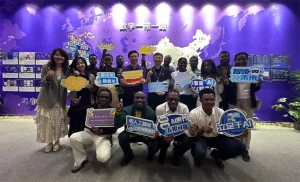
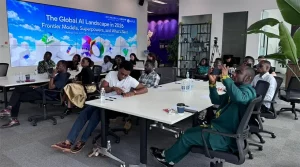
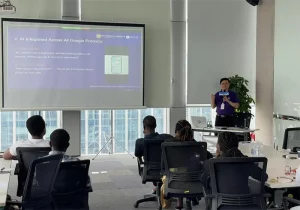
The hybrid gathering, which saw 30 students attend in person in Beijing and over 290 students join virtually from Ghana, was far more than a lecture. It was a declaration — that geography is no longer a barrier to world-class technological education, and that Africa’s youth deserve a seat at the global AI table.
“The conclusion of our first lecture marks not the end, but the official beginning of an exciting AI learning journey.”
Kojo Bonsu Gen Z AI Club
Decoding the Future: The Keynote Speaker
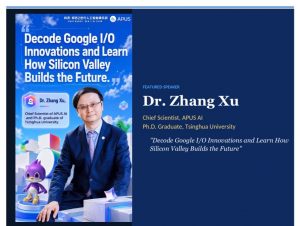
The inaugural session was anchored by a masterful keynote from Dr. Zhang Xu, Chief Scientist of APUS AI and a distinguished Ph.D. graduate of Tsinghua University — one of China’s most prestigious academic institutions. Under the compelling theme, “Decode Google I/O Innovations and Learn How Silicon Valley Builds the Future,” Dr. Zhang offered attendees an exclusive, expert-guided tour through the cutting-edge developments reshaping the global technology landscape.
With a rare combination of academic rigour and industry authority, Dr. Zhang demystified the complex innovations unveiled at Google I/O, translating Silicon Valley’s most ambitious breakthroughs into accessible, actionable insights for a new generation of African and Chinese innovators. His lecture illuminated not only the what of AI’s current frontier, but the how — providing students with a practical understanding of the processes, philosophies, and engineering cultures that drive the world’s most powerful technology companies.
APUS Headquarters: Where the Future Was Taught
The choice of venue was itself a statement of intent. By hosting the inaugural lecture at the APUS Headquarters in Beijing, the organisers placed the event at the very heart of one of China’s most dynamic and forward-thinking technology companies. The gleaming offices of APUS — a firm whose products reach hundreds of millions of users globally — provided the perfect backdrop for a lecture designed to inspire the next generation of innovators.
APUS has made a firm and public commitment to this educational mission. The company has pledged to make Artificial Intelligence simple to learn for the students of the Gen Z AI Club, ensuring that the knowledge imparted is not only academically rigorous but genuinely accessible and immediately beneficial — both for the students in China and for the broader cause of Ghana’s national development.
“Science and Technology must be a tool for solving problems amongst students, and ultimately a force for solving societal challenges in Ghana. That is why I agreed to collaborate with Ambassador Kojo Bonsu.”
Captain Li Tao, CEO of APUS
Captain Li Tao: A CEO with a Continental Vision
At the launch of the Kojo Bonsu Gen Z AI Club, Captain Li Tao, Chief Executive Officer of APUS, delivered a powerful and deeply personal commitment to the initiative. Speaking with the conviction of a leader who understands that technology’s true measure lies not in its complexity but in its impact, Captain Li Tao declared that Science and Technology must serve as a practical tool for problem-solving among students — and that this problem-solving capacity must ultimately scale to address the broader societal challenges facing Ghana.
It was precisely this shared philosophy — that innovation must be purposeful, accessible, and development-oriented — that drew Captain Li Tao to collaborate with H.E. Ambassador Kojo Bonsu. The partnership between APUS and the Gen Z AI Club is therefore not merely a corporate sponsorship; it is a strategic alignment of values between two leaders who believe that the most powerful application of Artificial Intelligence is the empowerment of people.
A Truly Global Classroom
The event’s reach was a powerful demonstration of the club’s cross-continental mission. The hybrid format proved remarkably effective, creating a unified learning environment that transcended physical distance.
|
Location |
Attendance |
Mode |
Region |
|
Beijing, China |
30 |
In-Person |
East Asia |
|
Ghana |
290+ |
Virtual |
West Africa |
|
Total |
320+ |
— |
Global |
The impressive turnout — particularly the more than 290 students who dialled in from Ghana — underscores a profound and urgent hunger for advanced technological education among the youth of West Africa. It also reflects the extraordinary organisational reach of the club, which managed to mobilise a substantial virtual audience for its very first ever
The Visionary Behind the Initiative
This groundbreaking initiative is the brainchild of His Excellency Kojo Bonsu, Ghana’s Ambassador to the People’s Republic of China. Driven by a profound and personal commitment to youth empowerment, Ambassador Bonsu established the Gen Z AI Club as a direct response to what he identifies as one of the most pressing challenges facing developing nations: the widening technological skills gap between the Global North and the Global South.
By offering these lectures entirely free of charge, H.E. Kojo Bonsu is dismantling the financial and geographical barriers that have historically prevented young Africans from accessing world-class technological training. His initiative ensures that students in both China and Ghana can acquire the AI skills that will define the economy of tomorrow — not as passive consumers of technology, but as its active architects.
The ambassador’s approach is as strategic as it is compassionate. By leveraging his diplomatic position in Beijing — the epicentre of China’s formidable AI ecosystem — H.E. Kojo Bonsu has been able to forge connections with leading technology institutions and industry leaders, channelling that expertise directly to the young people who need it most. His collaboration with Captain Li Tao and APUS is the centrepiece of this strategy: a partnership built on the mutual conviction that AI education, delivered freely and accessibly, is one of the most powerful investments any nation can make in its future.
The significance of this collaboration extends far beyond a single lecture series. It represents a new model of South-South cooperation in the digital age — one in which a West African diplomat and a Chinese technology CEO join forces to ensure that the benefits of the AI revolution are shared equitably across the developing world. For Ghana, the implications are profound: a generation of young people equipped with the skills to apply Artificial Intelligence to the country’s most pressing challenges, from agriculture and healthcare to governance and infrastructure.
Ambassador Congratulates the APUS Team
The spirit of the event did not dissipate when the final lecture slide was closed. In a gesture that underscored both his personal investment in the initiative and his deep appreciation for the APUS team’s contribution, H.E. Ambassador Kojo Bonsu met with the APUS team following the conclusion of the session to formally congratulate them on the resounding success of the inaugural lecture.
Speaking directly to the APUS team after the session, Ambassador Bonsu expressed his heartfelt gratitude for the professionalism, commitment, and warmth with which the company had hosted and facilitated the event. He commended the team for creating an environment in which students — both in the room in Beijing and thousands of kilometres away in Ghana — felt genuinely engaged, inspired, and valued.
Crucially, the Ambassador did not allow the moment to rest on its laurels. With characteristic energy and forward-looking determination, H.E. Kojo Bonsu urged the APUS team to increase the momentum — to build upon the extraordinary foundation laid by the first lecture and to redouble efforts to attract even more students to the club’s growing portfolio of activities. His message was clear: the first event had proven the concept; now was the time to scale the vision.
The post-event meeting served as a powerful signal to all stakeholders that the Kojo Bonsu Gen Z AI Club is not a one-off initiative but a sustained, evolving programme with the full backing of both diplomatic and corporate leadership. With Ambassador Bonsu’s encouragement ringing in their ears, the APUS team departed with a renewed sense of purpose and a clear mandate: to make the next lecture bigger, bolder, and more impactful than the last.
The Journey Has Only Just Begun
A heartfelt thank you to every Kojo Bonsu Gen Z AI Club member for their enthusiastic participation and deep engagement. This is not a conclusion — it is a launchpad.
As the digital horizon continues to expand at an unprecedented pace, the Kojo Bonsu Gen Z AI Club stands as a beacon of what is possible when diplomatic vision, technological expertise, and youthful ambition converge. The club has pledged to continue expanding its programme, with the aim of reaching even more young innovators across Ghana and beyond in the months and years ahead.
For the 320 students who participated in this inaugural lecture, the experience was more than an educational session — it was an invitation to join a movement. A movement that believes the next generation of AI pioneers may well emerge not from Silicon Valley or Shenzhen, but from Accra, Kumasi, and the cities of a rising Africa.
By International Correspondent · Beijing Bureau · Technology & Diplomacy · June 2025