
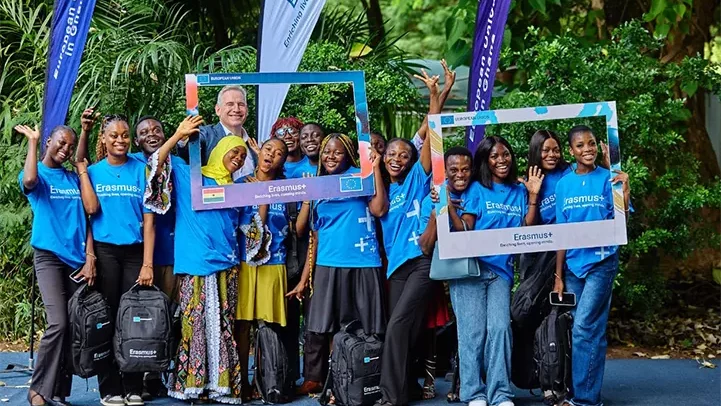
Ambassador Rune Skinnebach in a group photograph with the scholars
The European Union (EU) has awarded 446 Ghanaians with the prestigious Erasmus+ Scholarship Programme for 2026. This year’s scholarship awards include 28 students for the Erasmus Mundus Joint Masters, 14 of whom have received full scholarships to study in top universities across Europe, and 418 students and staff selected under International Credit Mobility, the short-term exchange programme.
Speaking at the event, the European Union Ambassador to Ghana, Rune Skinnebach, highlighted that these figures are important, but what matters even more is what they represent: “real opportunities, real ambitions, and real stories of transformation. This effort is made possible through a strong Team Europe approach.”
The Erasmus+ Programme is the EU’s flagship mobility initiative to support education, training, youth and sports in Europe under its Global Gateway initiative with a strong focus on social inclusion, green and digital transitions and promoting young people’s participations in democracy and efficient governance.
The Ambassador expressed EU’s pride in welcoming the new scholars, saying, “the EU is certainly proud of welcoming you to our top academic institutions in Europe, but today is not only a celebration of your success, it’s also a celebration of partnership between Ghana and Europe, between institutions and, above all, between people.”
He further underscored the broader scope of studying abroad, stressing that study opportunities in Europe are much more than academic achievement alone, “they are about learning, about discovery, about exchange and about building the skills and networks that will shape your future. They are also about strengthening mutual understanding and deepening the ties between Ghana and EU.”
Highlighting the financial commitment to youth empowerment, he noted that the European Union attaches great importance to education, youth and mobility. The EU Global Gateway initiative, Youth Mobility for Africa, dedicates €970 million towards youth exchanges and mobility between Africa and Europe, including Erasmus+ and other initiatives.
”Through Erasmus+, we invest in people, in knowledge, and in long-term partnerships. Since 2014, 3,618 Ghanaian students and staff have travelled to Europe for study, training or teaching opportunities,” the Ambassador disclosed.
Emphasising the collaborative nature of the initiative, he stated that this effort is made possible through a strong Team Europe approach. “Promoting Study in Europe and Ghana is a shared endeavour. In partnership with GIZ, through the Ghanaian-European Centre for Jobs, Migration and Development, we have established a network of ‘Study in Europe’ desks in 30 Ghanaian universities.”
According to him, these desks play an important role in raising awareness of opportunities in Europe by providing information sessions and counselling on Erasmus+, as well as on programmes offered by Campus France and DAAD, the German Academic Exchange Service.
Looking beyond the academic period, he urged continuous engagement, stating, “We want your journey with the EU not to end when the scholarship ends, and this is why we are looking to build a stronger alumni community to keep young beneficiaries of EU programmes engaged, connected and informed about future opportunities.”
”Also, we are proud to work closely with ASAF, the African Student Alumni Forum, which plays an important role in connecting and mobilising young alumni across the continent, as well as with the Erasmus Mundus Association, and I’m also grateful for the presence of the Erasmus Plus National Focal Point,” he added.
Concluding his address, Ambassador Skinnebach encouraged students to be curious, ambitious, as well as open to new ideas, to new friendships, and to new perspectives. He charged them to learn as much as they can and carry Ghana proudly with them, reminding them that they are not only students, but future leaders, professionals, and bridges between Ghana and Europe, adding that, he “hope to see them come back as EU ambassadors to Ghana.”
By Janet Odei Amponsah