
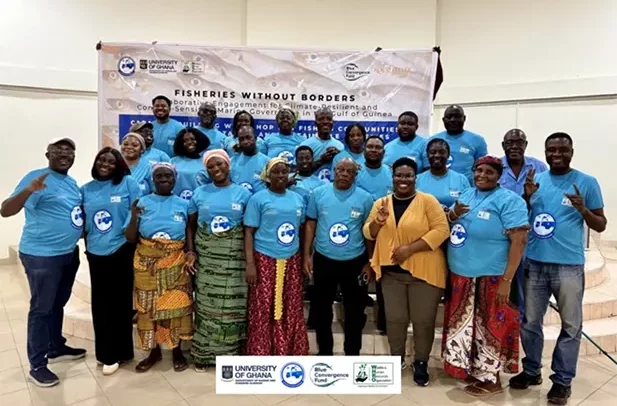
Participants and stakeholders in a group photograph
‘Fisheries Without Borders’ (FWB) has organised a capacity-building workshop for fishermen, fish processors, community leaders and marine scientists as part of efforts to strengthen sustainable fisheries management in the face of climate change.
The workshop, held at the Conference Hall of the National Fisheries Association of Ghana (NAFAG), formed part of a regional initiative involving Ghana, Nigeria and Benin aimed at addressing declining fish stocks in the Gulf of Guinea through collaborative fisheries management.
Ghana’s fisheries sector continues to face significant pressure, with fish catches declining sharply over the past three decades. Marine landings have dropped from about 900,000 tonnes to approximately 400,000 tonnes, raising concerns about food security and livelihoods.
Ghana Country Lead for the FWB project and faculty member at the University of Ghana’s Department of Marine and Fisheries Sciences, Professor F.K.E. Nunoo, said the situation requires a new approach that places communities at the centre of fisheries management.
He explained that introducing co-management systems alone would not guarantee improved food security, livelihoods or sustainability unless communities understand their roles in making such systems effective.
One of the facilitators, Dr. Angela Lamptey, Senior Lecturer at the University of Ghana and Chairperson of the Scientific and Technical Committee of the Fisheries Commission, took participants through areas including fisheries co-management, ethical principles, rights-based approaches, climate resilience and community governance.
Dr. Lamptey stressed that fisheries regulations are more effective when fishers participate in developing them, adding that women and young people must also be represented in decision-making processes.
She noted that traditional knowledge from experienced fishers and community elders remains valuable and should complement scientific approaches in fisheries management.
According to her, co-management systems built on accountability, shared responsibility and community participation offer one of the most effective ways of addressing the overexploitation of shared marine resources.
President of the National Fisheries Association of Ghana, Nana Jojo Solomon, encouraged participants to share the knowledge acquired with members of their respective fishing communities.
A member of the project’s collaborating partners team, Dr. Andrews Agyekumhene, conducted baseline and endline surveys during the workshop to assess changes in participants’ knowledge and confidence.
Prof. Nunoo said although one workshop cannot transform the entire fisheries sector, it can help lay the foundation for the reforms needed to protect Ghana’s marine resources.
The FWB project is funded by Rockefeller Philanthropy Advisors through the Blue Convergence Fund and runs until 2027, with similar training programmes taking place in Nigeria and Benin.
Ghana’s Department of Marine and Fisheries Sciences at the University of Ghana serves as the national lead for the project, with the Wildlife and Human Resource Organisation (WHRO Ghana) supporting community engagement and coordination.
By Ebenezer K. Amponsah