
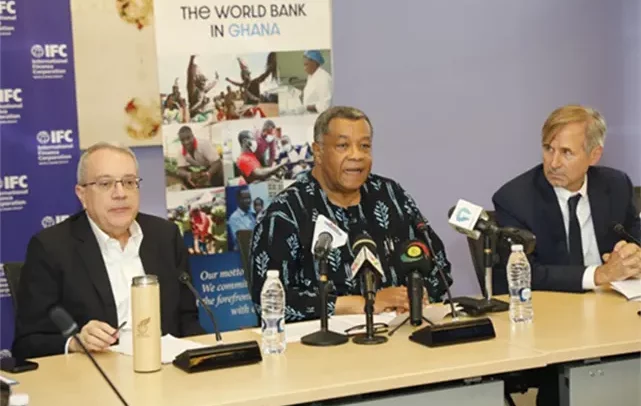
Goosie Tanoh (M), Robert Taliercio (L), and Kyle Kelhofer
Ghana recorded its lowest performance in operational efficiency, scoring 52 points and placing the country in the bottom 40 per cent among all assessed categories in the latest Business Ready (B-Ready) report by the World Bank.
The findings show that Ghana’s overall business readiness ranges from 72 per cent in financial services to 34 per cent in market competition, with scores of 69 points in regulatory framework and 50 points in public services out of 100.
In the financial services sector, Ghana was noted for having well-developed secured transactions and regulations governing electronic payments highlighting labour as one of the country’s strongest performing areas.
It stated, “With 71 points out of 100, Ghana ranked in the top 20 per cent globally for labour, driven by effective labour dispute resolution mechanisms that support job reallocation and productivity.”
Speaking with the media on the sidelines during a presentation on the report and working session with stakeholders on the Business Ready (B-READY) report at the World Bank Country Office in Accra, Presidential Advisor on the 24-Hour Economy, Goosie Tanoh, said Ghana’s performance shows promise but also exposes structural challenges citing the area of operational efficiency which has to be improved upon.
B-READY Report
The B-READY report produced by the World Bank compares Ghana’s investment climate and business environment with countries across the world, identifying areas of strength and weakness to guide reforms aimed at boosting exports, strengthening competition, growing the economy and creating sustainable jobs for Ghanaians.
Mr. Tanoh explained that for the private sector to become the engine of economic growth, public institutions must be more responsive while still enforcing regulations adding that weak operational efficiency indicates the need to better equip businesses to meet compliance requirements.
Touching on energy costs as a major constraint to business growth, he said the 24-Hour Economy initiative is anchored on renewable energy, particularly solar power noting that energy generated within industrial parks, agro-ecological parks and along the Volta Economic Corridor is expected to be supplied at prices as low as $0.07 per kilowatt hour, and in some cases $0.04, to encourage investment and reduce energy costs.
He also pointed to trade facilitation challenges, noting that while Ghana clears goods within 14 to 19 days, some countries such as Cameroun achieve clearance in about seven days and added that the report served as the baseline rather than a scorecard.
For his part, World Bank Division Director, Robert Taliercio, said the key finding of the report is that Ghana’s challenge lies more in implementation than in policy design.
He said the World Bank is working closely with the Ghana Investment Promotion Centre, the 24-Hour Economy Secretariat and other stakeholders to address constraints facing the private sector and improve the investment climate stating that job creation remains the Bank’s top priority in its engagement with the country.
International Finance Corporation (IFC), Senior Country Manage, Kyle Kelhofer, said while Ghana performed well in some areas, low scores in competition highlight the need for stronger competition policy, improved market access and increased opportunities for value addition.
He noted that more than 90 per cent of jobs in Africa are created by the private sector, and therefore emphasised the need for stakeholders to support businesses in order to drive agricultural productivity, manufacturing growth, export expansion and import substitution.
By Ebenezer K. Amponsah