
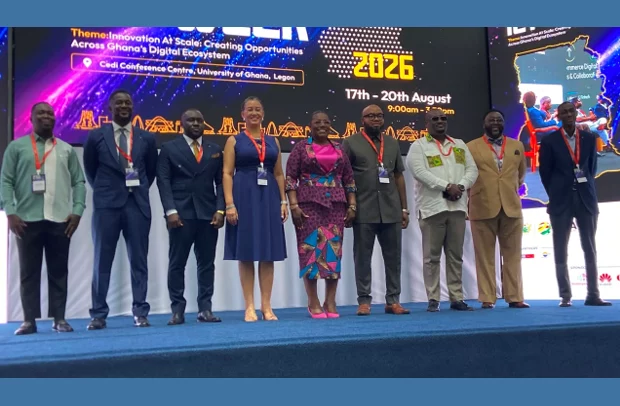
Mohammed Adam Sukparu, Nana Yaw Amoah-Yeboah with other stakeholders
The government has announced plans to deploy advanced connectivity technologies, including 5G, as part of efforts to accelerate digital transformation and drive economic growth.
Deputy Minister of Communications, Digital Technology and Innovations, Mohammed Adam Sukparu, who disclosed this at the opening of the 2026 National ICT Week celebration in Accra, said technology had become a major driver of economic growth, public service delivery, innovation and national development.
He said the government was building the necessary policies, institutions, infrastructure, skills and partnerships required to harness opportunities in the digital economy.
The Deputy Minister said the government was undertaking reforms to facilitate greater investment and competition in the telecommunications sector while ensuring that spectrum resources supported wider access and public value.
He added that the government’s efforts included reviewing spectrum policies to support investment and the deployment of connectivity infrastructure, which would provide the foundation for emerging technologies such as 5G, artificial intelligence and cloud computing.
Mr Sukparu said the nation’s digital transformation agenda was also being supported by initiatives such as the National Artificial Intelligence Strategy, launched in April 2026, which provides a framework for the responsible and inclusive adoption of artificial intelligence.
“The strategy provides a national framework for the responsible and inclusive adoption of artificial intelligence, with emphasis on data governance, infrastructure, talent development, ethical use and practical application across sectors of the economy,” he stated.
Director-General of the National Information Technology Agency (NITA), Nana Yaw Amoah-Yeboah, said the theme for the celebration reflected the need for the country to move beyond isolated innovations and focus on solutions that could be adopted and sustained.
He said NITA would continue to provide technical direction, ICT standards, coordination, interoperability and shared digital infrastructure to support the country’s digital transformation.
Mr. Amoah-Yeboah also disclosed that more than 600 government institutions and assemblies had been onboarded onto the SmartWeb platform, which demonstrates the impact of shared digital platforms in improving efficiency and reducing duplication.
The Deputy Chief of Staff in charge of Administration, Nana Oye Bampoe Addo, for her part, reaffirmed the government’s commitment to improving the country’s digital transformation, adding that Ghana was positioned to take advantage of the growing global digital economy.
She said the global digital economy was projected to reach $28 trillion this year, accounting for about 22 per cent of global Gross Domestic Product (GDP), with growth nearly three times faster than that of the global economy.
According to her, the government’s digital transformation agenda was being implemented through a five-point approach under the Reset Agenda, focusing on expanding digital infrastructure, digitalising public services, investing in digital skills, supporting entrepreneurship and innovation, and strengthening cybersecurity and data protection.
The Deputy Chief of Staff acknowledged the digital gaps that remained across Africa, noting that only 36 per cent of Africans had access to the internet, compared with the global average of 74 per cent, while women’s connectivity, at 31 per cent, continued to lag behind that of men.
She said the government was addressing these challenges through targeted interventions aimed at ensuring inclusion, equality and safety in the digital space.
The National ICT Week 2026, which started on Monday, August 17, and ends on Thursday, August 20, 2026, is being held under the theme, “Innovation at Scale: Creating Opportunities Across Ghana’s Digital Ecosystem.”
By Ebenezer K. Amponsah