
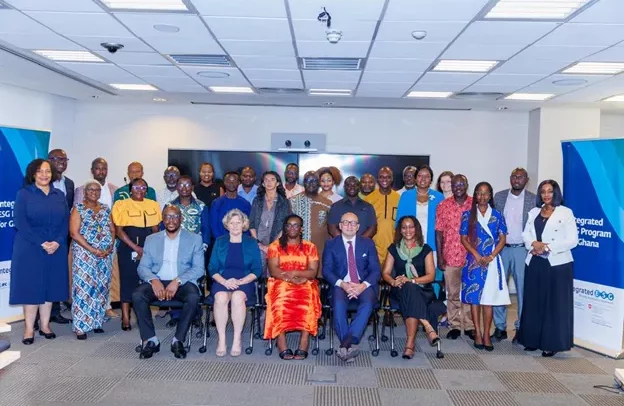
IFC officials and other stakeholders present at the ESG Roundtable
The International Finance Corporation (IFC), a member of the World Bank Group, has called for stronger collaboration among development partners to accelerate the adoption of environmental, social and governance (ESG) standards that promote sustainable private sector growth and long-term economic development in the country.
The call was made during the ESG Roundtable for Development Partners, which brought together representatives from the World Bank Group, GIZ, KfW, the United Nations Development Programme (UNDP), the Swiss State Secretariat for Economic Affairs (SECO) and other organisations working within Ghana’s ESG landscape.
The meeting provided a platform for participants to exchange ideas on ongoing ESG initiatives, identify areas of collaboration and improve coordination to maximise the impact of sustainability interventions across the country.
Opening the roundtable, IFC Senior Country Officer for Ghana, Yewande Giwa, said ESG considerations had become a key driver of business competitiveness, investment readiness and sustainable economic growth.
She stressed that ESG was no longer a separate agenda but an integral part of private sector development, helping businesses improve governance, transparency, accountability and community engagement while managing risks more effectively.
According to Ms. Giwa, development partners are pursuing similar objectives through different programmes, making greater collaboration essential to avoid duplication and enhance results.
“We all have the same goal, but we are implementing different activities. There is a clear opportunity for coordination, improved visibility of our efforts and stronger collaboration so that together we can make a greater impact,” she said.
Participants observed that environmental and social risks are increasingly translating into business risks that could affect investment decisions, operational performance and long-term profitability.
Environmental and Social Risk Management Specialist at IFC, Damilola Sobo Smith, said businesses that fail to manage environmental and social risks expose themselves to operational disruptions, regulatory sanctions, reputational damage and financial losses.
She explained that IFC’s Integrated ESG Programme is supporting businesses to adopt international environmental and social best practices while working with the Bank of Ghana to strengthen implementation of the Ghana Sustainable Banking Principles.
The programme is helping financial institutions incorporate environmental and social risk management into their governance structures, operations and lending practices.
Ms. Smith also commended Ghana for demonstrating leadership in sustainable finance through regulatory reforms that encourage responsible business practices.
Deputy Head of Cooperation at the Swiss Embassy, Magdalena Wüst, underscored the importance of a resilient and sustainable financial sector in driving investment, business expansion and job creation.
She noted that SECO has partnered with IFC in Ghana for more than a decade to strengthen environmental and social risk management, support regulatory reforms and build the capacity of financial institutions to implement sustainable banking standards.
She said advancing sustainable finance requires strong partnerships capable of strengthening institutions and delivering lasting development impact.
The roundtable ended with participants committing to deepen collaboration, leverage their respective expertise and coordinate efforts to address emerging ESG challenges while promoting sustainable economic growth in Ghana.
A Business Desk Report