
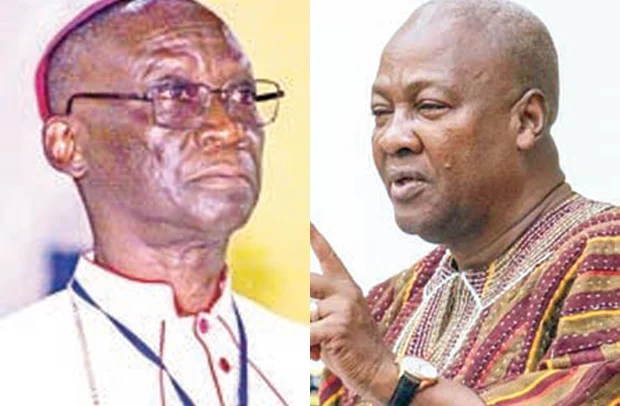
Most Rev. Matthew Kwasi Gyamfi, President John Dramani Mahama
The Ghana Catholic Bishops’ Conference has pushed back against recent remarks by President John Dramani Mahama, insisting that Ghana’s development cannot be reduced to economic concerns alone, but must equally reflect the nation’s moral and social foundations.
In a statement issued yesterday and signed by its President, Most Rev. Matthew Kwasi Gyamfi, the Conference cautioned political leaders against trivialising ongoing national debates on LGBTQ+ issues and family values.
The Bishops were responding to comments attributed to the President, who described LGBTQ+ matters as “not the most important issue” facing the country, as well as remarks by the Minister for Government Communications, Felix Kwakye Ofosu, who characterised the issue as a “waste of time” and not a priority for citizens.
While acknowledging that such statements may have been intended to highlight pressing economic challenges, the Catholic Bishops warned that sidelining moral questions risks weakening the very fabric of society.
“Even if intended to prioritise urgent socio-economic concerns, such descriptions risk conveying that certain moral questions may be set aside as inconsequential,” the statement said.
“Yet no question that touches the structure of human identity, family life, and social continuity can be trivial. Nations do not live by bread alone. They are sustained also by the invisible architecture of values,” the statement added.
The Catholic Bishops recognised the weight of the country’s current economic difficulties, including inflation, unemployment and gaps in essential services.
They, however, rejected any attempt to frame a choice between economic progress and moral responsibility, intimating that the two are “not rivals but companions.”
According to the Bishops, strong family systems remain central to national development, contributing to improved education outcomes, lower crime rates and enhanced economic mobility.
They described the family as the foundation of social order and civic responsibility, while reaffirming their doctrinal stance.
The Bishops stated that for many Ghanaians, the debate over LGBTQ+ issues is deeply rooted in cultural and religious convictions.
“By ‘family values,’ we refer to the understanding of marriage as a lifelong union between one man and one woman, ordered toward mutual good and the procreation and formation of children,” the statement explained.
At the same time, the Bishops emphasised that upholding family values must go hand in hand with respect for human dignity.
They condemned all forms of violence, hatred and unjust discrimination against individuals, regardless of sexual orientation or identity.
“No individual may be subjected to violence, hatred, or unjust discrimination. Such acts are moral failures and social wounds. We condemn them without reservation,” the statement stressed.
The Catholic Bishops also weighed in on the controversial Human Sexual Rights and Family Values Bill, noting that they had closely monitored its progress in Parliament.
They recalled what they described as prior assurances from President Mahama regarding assent to the bill if passed.
“Should Parliament complete its deliberations and pass the bill, we urge the President to honour this assurance,” the Bishops stated, while acknowledging that aspects of the legislation may require careful scrutiny and refinement to align with constitutional protections and human rights.
The Bishops further warned that dismissing the debate as insignificant risks alienating large sections of the population for whom such issues carry deep moral and existential importance.
“To describe such a debate as a ‘waste of time’ risks alienating citizens for whom these issues are existentially meaningful,” the statement added.
They called for a more measured national conversation involving government, Parliament, religious bodies, traditional authorities and civil society, urging that such engagement be guided by respect, intellectual rigour and moral clarity.
“Words can either build a republic of trust or fracture it into suspicion,” the Conference cautioned.
By Ernest Kofi Adu