
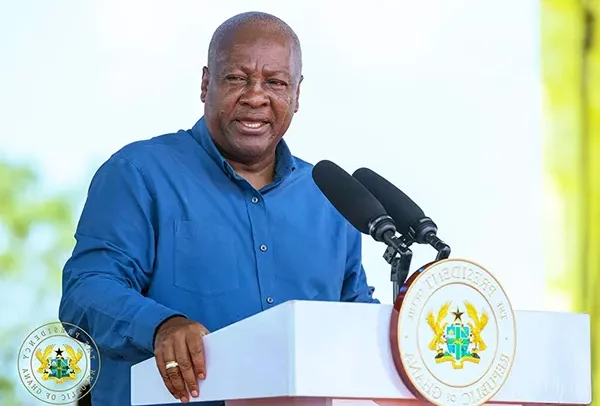
President John Mahama
President John Mahama has called on public institutions, particularly regulatory agencies responsible for issuing permits, to streamline their processes and procedures in order to prevent businesses from struggling to obtain permits.
Speaking at the 22nd Ghana Club 100 Awards, President Mahama stated that excessive regulatory requirements could ‘suffocate businesses, and therefore urged regulatory institutions to adopt a more friendly approach when serving people that want to register their businesses and require one form of support or the other.
“Regulators have a tendency to suffocate businesses. Regulatory agencies must put themselves in the position of applicants and assess whether they would be satisfied with the services they receive.
“Government is going to be an enabler, we are not going to be the operator of the new economy. The new economy will be implemented by the private sector,” he noted.
President Mahama also called on the Ghana Investment Promotion Authority (GIPA), Ministry of Trade, and other agencies to collaborate and work to provide seamless services to businesses as operating permits, licences and environmental impact assessment certificates among other business regulatory requirements should be easier to obtain.
The President cited his experience as Minister of Communications and recounted how he resisted proposals to introduce licensing requirements for internet cafés when those businesses started in the country adding that licensing the businesses could have delayed their expansion and prevented the country from taking advantage of the opportunities presented by the internet revolution at the time.
He also urged the Ministry of Trade and other stakeholders to address congestion and delays at the ports, stating that inefficiencies in their work affect local businesses while reaffirming the government’s commitment to sustaining macroeconomic stability and fiscal discipline, arguing that predictable economic conditions are essential for businesses to plan, invest and expand.
He further encouraged indigenous businesses to prepare themselves to benefit from the proposed US$10 billion New Economy Programme, which he said would be driven by private sector investment across eight economic pillars while commending companies that had sustained their operations, created jobs and continued investing in Ghana despite challenging economic conditions.
The 22nd Ghana Club 100 Awards, organised by the Ghana Investment Promotion Authority (GIPA) brought together several companies and held under the theme, “Investing in Ghana’s New Economy: Building a Productive Economy that Creates Value and Competes Globally”.
By Ebenezer K. Amponsah