
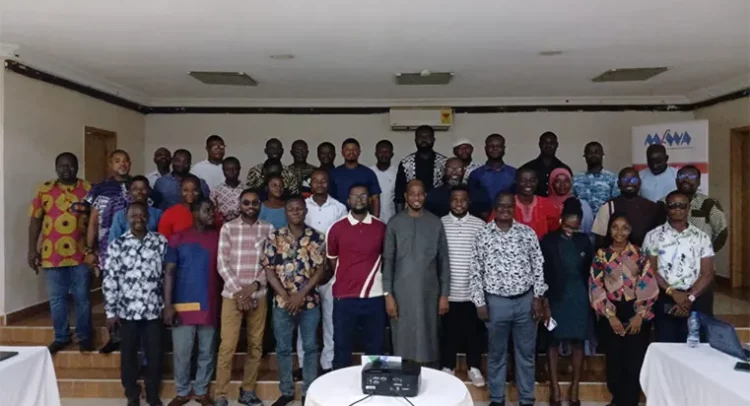
A group photograph of the facilitators and participants
The Media Foundation for West Africa (MFWA) and the Participation, Accountability, Integrity for a Resilient Democracy (PAIReD) and GIZ Ghana Programme have challenged media owners, managers and editors to adapt and implement a Model Safety of Journalists Policy to protect media practitioners against attacks, threats and intimidation in the line of duty.
The three organisations warned that failure by media houses to prioritise journalists’ safety could undermine press freedom, weaken democracy and discourage investigative reporting on sensitive national issues.
The Programme Director of MFWA, Dr. Kojo Impraim, and the Technical Advisor of PAIReD GIZ Ghana, Jonathan Donkor, made the call at a one-day workshop for journalists, editors and media managers in Kumasi on Wednesday, November 18, 2026.
The workshop, held on the theme, “Developing and Implementing Newsroom Safety Policy,” was aimed at equipping media practitioners with the knowledge and skills to adapt and implement the model policy in their respective newsrooms.
Dr. Impraim said journalists played a critical role in informing the public, exposing wrongdoing, holding people in authority accountable and strengthening democracy, but continued to face physical attacks, threats, online harassment, legal pressure, intimidation and psychological trauma.
He noted that the dangers confronting journalists went beyond election coverage, citing demonstrations, illegal mining investigations, government corruption, abuse of power and human rights violations as some of the sensitive assignments that exposed media practitioners to serious risks.
He cited the unresolved murder of investigative journalist Ahmed Suale as a painful reminder of the dangers confronting journalists in Ghana, lamenting that justice had yet to be served.
Providing statistics on press freedom violations, Dr. Impraim disclosed that MFWA recorded 32 violations across 12 West African countries in the first quarter of 2026, with the figure increasing to 44 in the second quarter and rising further in the third quarter.
He warned that attacks on journalists did not only affect the victims but also threatened society’s right to information, explaining that journalists who operated in unsafe environments could become reluctant to pursue sensitive stories, thereby weakening the media’s ability to hold public officials accountable.
Dr. Impraim explained that the Model Safety of Journalists Policy provided practical guidelines for media organisations to establish safety systems covering risk assessment, newsroom security, physical and online protection, legal assistance, emergency response, incident reporting and psychological support.
He further disclosed that MFWA had introduced a legal support fund to assist journalists who qualified for assistance under its guidelines.
Mr. Donkor, on his part, stressed that journalists must be protected to enable them to continue serving as the voice of the voiceless.
He observed that many people entered journalism with the ambition of speaking for marginalised and vulnerable groups, but said such a noble responsibility also required journalists to remain safe enough to tell their next stories.
Mr. Donkor disclosed that the collaboration between PAIReD GIZ Ghana and MFWA had contributed to strengthening the capacity of journalists, including senior and investigative reporters, while advocating a safer environment for media practice.
He described the Model Safety of Journalists Policy as one of the important outcomes of the collaboration and commended MFWA for moving beyond developing and launching the document to training journalists and media managers on how to adapt and implement it.
He expressed the hope that the policy would become a reference point for media owners, managers, editors and journalists whenever issues concerning newsroom safety arose.
Mr. Donkor reaffirmed PAIReD GIZ Ghana’s commitment to supporting efforts aimed at protecting journalists who become victims of harassment and intimidation.
Training Sessions
Participants were taken through several important topics by a Consultant and Lecturer at the University of Media, Arts and Communication-Institute of Journalism (UniMAC-IJ), Dr. Martin Thompson Ntem.
The topics included understanding newsroom risks, covering physical, digital, legal, psychological and gender-related threats; key provisions of the safety policy; prevention and preparedness; incident reporting; response mechanisms; support and accountability.
Other areas covered included newsroom safety audits, identifying existing protective measures and gaps, as well as introducing the Model Safety of Journalists Policy, its purpose, scope, principles and structure.
The sessions were designed to help media organisations assess their existing safety arrangements, identify weaknesses and establish practical mechanisms to protect journalists throughout their assignments.
The project is being implemented under the Participation, Accountability, Integrity for a Resilient Democracy (PAIReD) Programme, commissioned by the German Federal Ministry for Economic Cooperation and Development (BMZ), co-financed by the European Union (EU) and the Swiss State Secretariat for Economic Affairs (SECO), and implemented by GIZ Ghana in cooperation with the Ministry of Finance.
FROM David Afum, Kumasi