
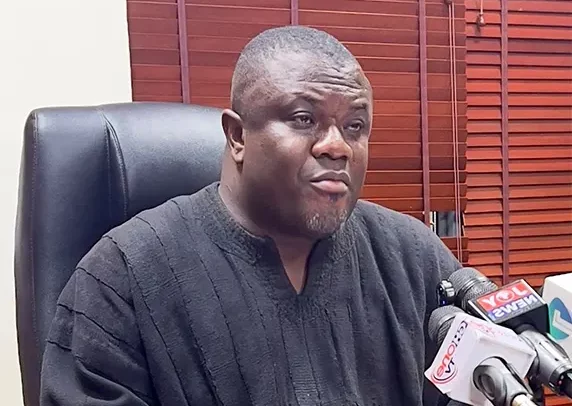
Collins Adomako Mensah addressing the media
The Minority in Parliament has launched a scathing attack on the government over the latest electricity tariff increase announced by the Public Utilities Regulatory Commission (PURC), accusing President John Dramani Mahama and the National Democratic Congress (NDC) administration of reneging on campaign promises to reduce the cost of living.
Addressing a press conference in Parliament yesterday, the Deputy Ranking Member on Parliament’s Energy Committee, Collins Adomako Mensah, described the 3.49 percent increase in electricity tariffs and 0.85 percent rise in water tariffs, effective July 1, 2026, as evidence of what he termed a “broken promise” by the government.
According to him, Ghanaians are now paying significantly more for electricity than when the NDC assumed office in January 2025 despite repeated assurances that utility costs would be reduced.
“Eighteen months into their tenure, Ghanaians are paying 26.82 percent more for electricity than they were when President Mahama took the oath of office. That is a broken promise,” Mr. Adomako Mensah stated.
The Minority cited data showing a series of tariff increases since the beginning of 2025, including adjustments of 14.75 percent in the second quarter of 2025, 2.45 percent in the third quarter, 1.14 percent in the fourth quarter, and 9.8 percent in the first quarter of 2026.
Although tariffs were reduced by 4.81 percent in the second quarter of this year, the opposition argued that the latest increase had effectively wiped out that relief.
Mr. Adomako Mensah said government officials had celebrated the April tariff reduction as proof of an economic turnaround, but insisted the adjustment was merely a technical consequence of temporary gains in the value of the cedi and lower inflation.
“With this latest increase, that so-called relief has been erased within a single quarter. The reduction lasted exactly 91 days,” he said.
The lawmaker further argued that the continued rise in electricity costs was imposing an unbearable burden on households and businesses, particularly at a time when workers had received only a 10 percent wage increase.
He maintained that rising utility costs were undermining the government’s flagship 24-hour economy agenda and threatening the competitiveness of local industries.
“The 24-hour economy cannot run on 26.82 percent more expensive electricity. Jobs cannot be created when the cost of powering a factory keeps climbing every quarter,” he said.
Questioning the rationale behind the latest tariff adjustment, the Minority noted that the PURC had cited a cedi-dollar exchange rate of GH¢11.2228 to one US dollar, representing only a 0.2 percent depreciation from the previous quarter.
The Minority also pointed out that natural gas costs had declined by 1.58 percent while the generation mix remained unchanged.
“If the cedi depreciated by only 0.2 percent between quarters, how does this justify a 3.49 percent increase in electricity tariffs?” Mr. Adomako Mensah asked, calling for greater transparency in the tariff-setting process.
The Minority also rejected suggestions that the increases were linked to conditions under Ghana’s International Monetary Fund (IMF) programme.
According to Mr. Adomako Mensah, Ghana had exited the IMF Extended Credit Facility programme and was no longer bound by conditions requiring cost-reflective utility tariffs.
“The IMF excuse is gone. What Ghanaians are witnessing is a deliberate policy choice,” he said.
The caucus called on the government and the PURC to publish the detailed mathematical basis for all tariff adjustments since January 2025, ensure future tariff increases are tied to measurable improvements in service delivery, and review the 2026-2030 Multi-Year Tariff Order in light of what it described as improving macroeconomic conditions.
Mr. Adomako Mensah further questioned why utility tariffs continued to rise despite the government claims that the cedi had appreciated significantly, inflation was declining and interest rates were easing.
“This contradiction demands answers. If the strength of the cedi is real and inflation is falling, why are utility tariffs continuing to rise?” he asked.
The Minority warned that Ghanaians would hold the government accountable for rising utility costs and urged civil society organisations, trade unions and industry groups to demand greater transparency and fairness in utility regulation.
By Ernest Kofi Adu, Parliament House