
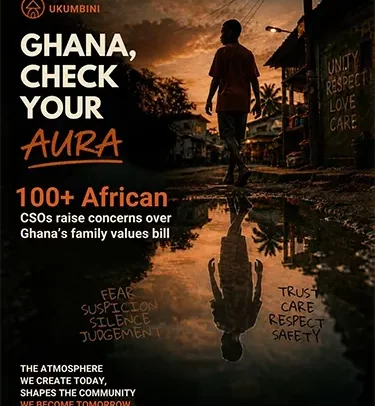
On 29 May 2026, Ghana’s Parliament passed the Human Sexual Rights and Family Values Bill on a voice vote. Thirty-two members were present. There are 276 seats. Ghana moved one of the most consequential pieces of social legislation in its recent history from introduction to passage without the deliberative record being available to the public it governs.
We are more than 100 civil society organisations working across Africa. We are asking President Mahama to send this bill back. #BackToSender.
The Exemptions That Leave Everyone Exposed
The bill’s supporters have pointed to carve-outs for healthcare workers, lawyers, and media professionals as evidence of proportionality. These exemptions protect professional conduct. They do not, and cannot, govern the environment those professionals operate within. A patient deciding whether to walk into a clinic does not consult a legal framework. They make a calculation in seconds, and the question is whether the risk of being identified, correctly or not, as LGBTQ+ outweighs their need for care.
Senegal enacted comparable legislation earlier this year. The effect on public health was not gradual. Within a single month, HIV treatment consultations fell by over 25% across treatment sites. Patients returned their antiretroviral medication boxes rather than risk collection. A country that had reduced HIV prevalence to 0.3% is watching that progress come undone, not because doctors began reporting patients, but because patients stopped coming. The professional exemption had nothing to say about that.
Ghana’s bill also does not answer the question of what a clinician may do with suspicion, as opposed to knowledge. In that silence, every frontline worker becomes a risk to be navigated rather than a resource to be trusted.
Family Values, Foreign Funding
This bill is framed as a defence of Ghanaian values. The 4th African Inter-Parliamentary Conference on Family and Sovereignty, hosted in Accra last week in deliberate alignment with the bill’s passage, was sponsored significantly by Family Watch International, CitizenGO, and the Alliance Defending Freedom. These are US-based evangelical organisations with a documented record of funding
anti-LGBTQ+ legislation across Africa and beyond. Ghanaian family values did not require outside sponsorship. They have held across centuries without it.
Two months ago, Ghana led a historic United Nations resolution declaring the transatlantic slave trade among the gravest crimes against humanity. That resolution named, with precision, what it means for the sovereignty of a people to be overridden by external actors with resources and reach. It would be a painful irony if the same Parliament that stood for that principle had, in the same season, allowed external actors with resources and reach to shape its domestic legislation. Ghana’s new standing in the international human rights arena was not built to be traded this way.
A Procedure Ghana Should Be Embarrassed to Export
Proponents of this bill have noted that no member of Parliament, including from the minority, formally raised a quorum objection on the floor. They present this as the matter being settled. It is not. The absence of an objection in the room does not constitute the presence of democratic legitimacy. Ghana’s Parliament exists to carry the weight of deliberation on behalf of 33 million people. That obligation does not dissolve because 244 elected members were absent and no one said anything at the time.
Ghana is a country that others on this continent look to. Its democratic credentials are not a domestic matter alone; they are part of what Ghana projects and what Africa has learned to rely on. The same Ghana that champions a pan-African human rights image at the United Nations cannot, without contradiction, shrug at a procedure in which landmark social legislation affecting millions of lives was passed in an emptied chamber. If that is the standard Ghana is prepared to defend, the rest of the continent deserves to know it.
Our Ask
We call on President Mahama to return this bill to Parliament, with instructions for a full sitting and a genuine public process before any further vote is taken. If this legislation truly carries the will of Ghanaians, it has nothing to fear from transparency. And if transparency is what is being avoided, Ghanaians are owed an explanation.
#BackToSender. #GhanaCheckYourAura.
Africa is watching, and learning, as it always has.
Media Contact
Ukumbini Futures Lab Imani A.