
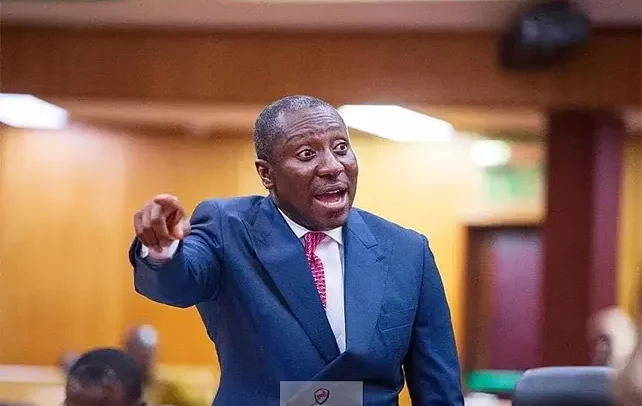
Alexander Afenyo-Markin
The Minority Caucus in Parliament has accused the government of betraying Ghanaians by allegedly reintroducing the controversial Electronic Transfer Levy (E-Levy) through a “backdoor” digital transaction charge.
Addressing a press conference in Parliament yesterday, the Minority Leader, Alexander Afenyo-Markin, said the newly announced 0.75 percent charge on wallet-to-bank transfers by Mobile Money Fintech Limited (MMFL) was effectively the return of the E-Levy under a different name.
He described the development as a betrayal of the Ghanaian people and “an affront to the Constitution.”
“There is a kind of political dishonesty worse than ordinary deception, condemning a sin loudly and repeatedly, then committing it the moment you gain the power to do otherwise,” Mr. Afenyo-Markin stated.
According to him, the National Democratic Congress (NDC) built its campaign around promises to abolish burdensome taxes introduced by the previous administration, particularly the E-Levy, only to now facilitate a similar charge after assuming office.
The Minority Leader recalled that in May 2022, President John Dramani Mahama described the E-Levy as “distortionary, burdensome, and a regressive tax that heaps more suffering on Ghanaians.”
He noted that the NDC repeatedly pledged during its time in opposition that it would abolish the tax if elected into government.
“The NDC did not whisper these promises. They shouted them from every platform, every market square, and every radio station in Ghana. Ghanaians believed them. Ghanaians voted for them,” he said.
Mr. Afenyo-Markin acknowledged that Parliament passed the E-Levy repeal bill on March 26, 2025, after which President Mahama signed it into law together with the repeal of the betting tax and emissions levy.
However, he argued that the introduction of the 0.75 percent transfer charge barely 14 months later amounted to a reversal of that promise.
“Call it what it is, not a service charge, not a processing fee. It is a levy on electronic financial transfers. It is the E-Levy in a new coat and under a new name, but identical in substance and effect to the burden President Mahama spent years denouncing,” he stressed.
The Minority Leader dismissed suggestions that the charge was solely a private decision by MMFL, insisting the government could not distance itself from the development.
“If the government were truly uninvolved, on what authority did the central bank order a private operator to suspend the charge for further consultation?” he questioned.
Mr. Afenyo-Markin further argued that the new transfer charge could have serious economic implications for businesses and traders.
He cited concerns raised by freight forwarders, noting that the sector heavily relies on wallet-to-bank transfers for customs payments, port charges and supplier settlements.
“Day one, it will raise the cost of doing business and erode competitiveness at our ports,” he warned.
The Minority also raised constitutional concerns over the charge, arguing that any levy on financial transactions must be authorised by Parliament under Article 174 of the 1992 Constitution.
“A charge on financial transactions that is economically indistinguishable from a levy cannot be made lawful simply by routing it through a private fintech firm instead of the Consolidated Fund,” he stated.
According to him, allowing a Bank of Ghana-regulated entity to impose a levy-equivalent charge after Parliament had repealed the E-Levy amounted to bypassing the legislature.
“If the government wants to re-impose transaction charges, it must come to Parliament, lay a bill, make its case, and face a vote,” he added.
Mr. Afenyo-Markin welcomed the Bank of Ghana’s decision to suspend the implementation of the charge pending consultations but insisted the Minority would not accept a temporary pause as sufficient.
“A suspension is not a repeal. A pause is not a principle,” he said.
He accused the government of operating with a pattern of saying one thing while doing another, citing issues including procurement, galamsey and cocoa sector management.
“This is not an aberration. It is the operating philosophy of this administration,” he declared.
The Minority consequently demanded that the Bank of Ghana permanently prohibit any wallet-to-bank or bank-to-wallet charge equivalent to a transaction levy unless approved by Parliament.
It also called on the Attorney General to issue a formal opinion on the constitutionality of the charge and urged the Finance Minister to appear before Parliament to explain the government’s role in MMFL’s announcement.
Mr. Afenyo-Markin further urged the government to apologise to Ghanaians for what he described as a broken electoral promise.
“Those market women are still there, President Mahama. Those mobile money agents are still there. They voted for relief because you made them trust you,” he said.
The Minority Leader vowed that the caucus would use every constitutional, legislative and democratic avenue available to resist what he termed a “backdoor levy.”
“We do not accept it. It is another attempt to impose it on Ghanaians,” he stated.
By Ernest Kofi Adu, Parliament House