
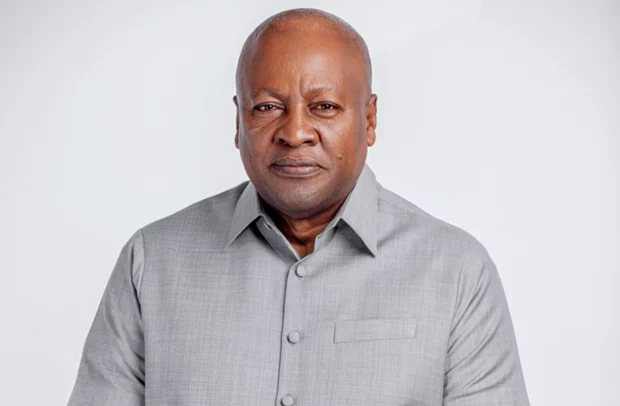
President John Mahama
The sanctity of the judiciary is being compromised by assortment of acts of omissions and commissions, a worrying situation which should not be overlooked.
Indeed, when the journey to remove the former Chief Justice, Gertrude Torkornoo as part of a judicial reset package began, the Commonwealth Lawyers Association (CLA) had cause to comment against the project, as did many in Ghana save those who saw no evil in the political manoeuvre.
The concerns raised by the group and others were ignored, and the infraction was effectively put on the dark chapters of the constraints of the separation of powers with the intention of achieving a goal which is anything but in the interest of good governance when the lady was forced out.
President John Mahama did not conceal his intention to change the state of the judiciary even when he was opposition leader.
His ‘unanimous Supreme Court’ allusion sought not only to subject this arm of government to public opprobrium but to prepare the stage for a vindictive agenda dubbed ‘resetting’, which has already claimed its first casualty – the image of the judiciary.
The Machiavellian ploy successfully swept away the former Chief Justice in a manner which can only be rivalled by the Sir Arku Korsah ouster in 1963.
Those who crossed the dots and ‘ts’ painted unambiguously a worrying picture of a tendentious reversal of a digitised supported system to reduce the human interface in the assignment of cases.
Cynics called the directive to have the Acting Chief Justice direct which cases go to which judges a reset order fraught with many obstacles to the rule of law.
Our judiciary has been turned through the deliberate and sustained efforts of politicians at the helm into an arm of government in an unholy alliance with the executive, as observed by the flagbearer of the New Patriotic Party (NPP).
This critical arm of government is effectively in the vitriolic mint of social media, unfortunately and effectively drawing comments not inuring to its image and which should be reserved to politicians already in the gutters of local abrasive politics.
The worrying trend taking place at a time when government’s tolerance for criticism is an all-time low and free speech criminalised has seen the number of persons being hauled before judges for such ‘infractions’ rising.
Some of the comments of the Minority Leader when he addressed a press conference last week on the subject, indicted the judge who ordered the remand of the Bono Regional Chairman of the NPP over verbal infractions. This is not good for the image of the judiciary and call for reflection and redress.
We particularly find the portion which touches on the reason behind the remand request by the prosecution rather interesting and disturbing. According to the Minority Leader, remanding the regional chairman because he could repeat the offence for which he was hauled before the judge as being basis for the remand order according to the court, he said, is tantamount to “the judiciary serving silence and not justice”. This we find worrying in a country where this proclivity should not have a place. A subtle gagging process as it were is the impression of the interpretation of the order by the Minority Leader.
Unfortunately, the Minority Leader, a learned gentleman of the legal fraternity, has questioned the basis for the action of the bench in this regard and unequivocally so.
The stage for such muddying of the judiciary was set by President John Mahama when he labeled the Supreme Court ‘Unanimous SC’. How else could he describe his mistrust of this arm of government and his readiness to reset it to conform to his whims? Now that he is President, are the infractions as noticed by the Minority Leader the outcome of the executive’s intervention to, as it were, reset the judiciary to fit the reset project?
When tomorrow comes and another reset agenda is undertaken to reverse the aberrations of today, the sanctity of the judiciary would have suffered another nose-bruising development.