
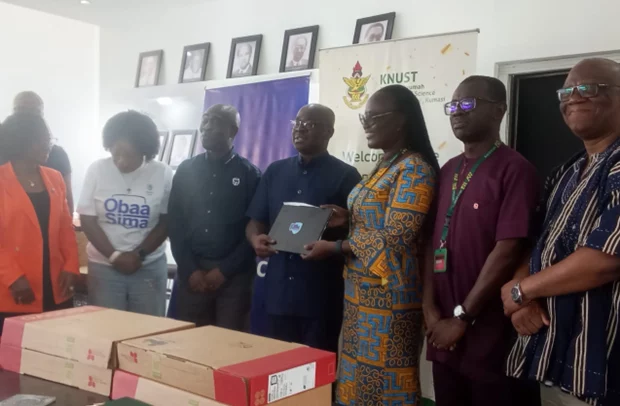
Mr. Kwamina Asomaning (4 L) presenting a laptop to Prof. (Mrs.) Rita-Akosua Dickson
Stanbic Bank Ghana has reaffirmed its commitment to youth empowerment and digital inclusion by donating 50 high-end laptops to students of the Kwame Nkrumah University of Science and Technology (KNUST) under the Support One Student with One Laptop (SONSOL) initiative.
The presentation was made at the Office of the Vice-Chancellor of KNUST on Thursday, April 30, 2026.
The Chief Executive Officer of Stanbic Bank Ghana, Kwamina Asomaning, who made the presentation, said the initiative aligns with the bank’s broader goal of driving growth through investment in young people.
He explained that Africa’s future depends largely on its youthful population, hence the bank’s decision to support the SONSOL initiative introduced by the Vice-Chancellor in 2020.
According to him, Stanbic Bank has so far donated 400 laptops under the project to assist students in their academic work and bring them closer to achieving their ambitions.
“These contributions underscore our belief that empowering the youth with the right tools and skills is essential to building a resilient and prosperous future,” he stated.
Mr. Asomaning stressed the importance of digital equity, noting that access to technology remains a key driver of education, employment and entrepreneurship in the modern economy.
He observed that women continue to face challenges in accessing digital resources and are underrepresented in Science, Technology, Engineering and Mathematics (STEM) fields.
To help bridge this gap, he disclosed that 40 out of the 50 laptops donated would be allocated to female students pursuing STEM-related programmes at KNUST.
“As a bank, we are deeply committed to improving the representation of women in STEM fields,” he added.
Receiving the items, the Vice-Chancellor of KNUST, Professor (Mrs.) Rita Akosua Dickson, expressed profound gratitude to Stanbic Bank for its sustained support over the years.
She noted that the university fully aligns with the bank’s vision and emphasised that the SONSOL initiative became even more critical during the outbreak of COVID-19 in 2020.
According to her, the pandemic compelled the university to quickly adopt innovative approaches to teaching and learning, including engaging students remotely from their homes.
She explained that although KNUST invested heavily in digital infrastructure to support online learning, many students were unable to fully participate due to lack of access to appropriate devices.
“The question was whether all students could connect to the system we were building, and for some, the answer was an emphatic no,” she said.
She pointed out that some students, through no fault of their own, came from disadvantaged backgrounds and had to rely on basic or inferior mobile phones, which limited their ability to engage effectively in academic work.
Professor Dickson indicated that this challenge necessitated reaching out to partners such as Stanbic Bank, which, she said, has consistently supported the university over the past five years.
“Anytime we knocked on your door, you have never turned your back on KNUST. Every year, you have been here, supporting the vision and ensuring that no student is left behind,” she stated.
She particularly commended the bank for its focus on supporting female students, describing it as a significant step towards addressing gender disparities in STEM.
She observed that although women are often marginalised, they have the potential to excel when given the needed support.
“When given even the slightest opportunity, you marvel at what these young women can achieve,” she added.
Professor Dickson stressed that the initiative goes beyond bridging the digital divide, noting that it is transforming the lives and future prospects of beneficiaries.
She also highlighted KNUST’s STEM for Girls Policy and lauded Stanbic Bank for being a key partner in nurturing and developing young talent.
According to her, the university remains committed to training market-ready and professionally equipped graduates who can compete not only in Ghana but globally.
She described Stanbic Bank’s continued support as a demonstration of its unwavering commitment to education and youth development, adding that the impact of the initiative will be felt for generations to come.
From David Afum, Kumasi