

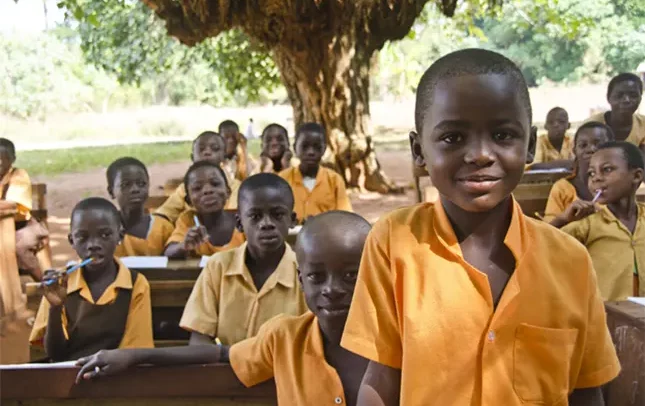
The school bell had rung five minutes earlier. Its echo had long dissolved into the midday air, swallowed by the familiar noise of a Ghanaian school in motion — the dragging of wooden chairs, the shuffling of feet on cement floors, the closing of classroom doors. Break was over. The world, as far as that school was concerned, had resumed its ordinary orbit.
But somewhere behind the snack bar, tucked into the narrow shadow it cast against the afternoon sun, a boy sat alone. He was nine years old, perhaps. His elbows rested on his knees, and both small hands cradled his chin as though his head had grown too heavy for his neck to carry. He was not playing. He was not eating. He had retreated somewhere deep inside himself, into a place that no school bell could reach and no teacher’s voice could summon him back from.
I was a part-time teacher at the school, taking a casual walk around the campus, when I found him there. He had not heard me approach. The world around him — the laughter from classrooms, the footsteps on the compound, the afternoon heat pressing itself against every surface — had ceased to exist for him. He was nine years old, and he was already somewhere else entirely.
I asked him why he was not in class with his friends. His answer was quiet. Almost a whisper. “They laugh at me,” he said. “They say I don’t know Maths.”
There was something in his voice that carried both the weight of truth and the careful softness of a child who has learned to edit his own pain before offering it to adults. I listened. Then I asked him to take me to his class.
He was in class four we walked together — a grown man and a small boy who moved as though he would rather be invisible — and entered the classroom. The other children looked up. Something made me turn, not toward the students, but toward the walls. And there it was.
Pinned to the wall of that classroom, as casually as a weather chart or a multiplication table, was the results sheet from their midterm examinations. Every child’s name. Every child’s score. Every child’s position — from first to last. And at the very bottom of that list, where the column of names finally ended, was his.
He was last. In a class full of children who would go home that afternoon and play and eat and sleep, this boy had built himself a private classroom behind the snack bar, because the one inside had a wall that announced, to anyone who cared to look, that he was the least among them.
This is not the first of these stories. I fear, deeply, that it will not be the last — unless we find the courage, as educators, as administrators, and as a society, to confront what we are doing to our children in the name of academic transparency.
I have watched this ritual repeat itself across the basic schools of Ghana; the termly ceremony of the results board, the social media post, the ranked list that moves through WhatsApp groups and Facebook pages like a verdict read aloud in a public square. A number beside a child’s name that tells everyone — not just the child, not just the parents, not just the teacher, but the entire community — how that child performed relative to every other child in the class. It is a practice so embedded in our educational culture that its cruelty has become invisible. We have mistaken familiarity for wisdom, and tradition for truth.
The practice of publicly ranking and displaying students’ academic results in Ghana’s basic schools is one that I believe constitutes a profound institutional failure — a failure of empathy, of pedagogical understanding, and of ethical responsibility. It is a practice that must be confronted with urgency, seriousness, and the full weight of educational research.
What makes it particularly disturbing is the context in which it persists. The vast majority of these schools have no educational psychologist on staff. No trained counsellor. No structured wellbeing programme. A child devastated by a public ranking has nowhere to turn within the institution that wounded them. There is no professional to help contextualise their results, to rebuild their confidence, to sit with them behind the snack bar and say: you are more than this number. The school inflicts the wound and then walks away.
Academic results are tools of management and individual decision-making. They are not instruments of public spectacle. My argument in this opinion is that the public display of students’ termly results causes measurable and lasting psychological harm, undermines the principles of inclusive education, and must be replaced by the model already in use at Ghana’s tertiary institutions — where results are made available privately to each student through an individualised dashboard, seen only by those with the right and the responsibility to act on them.
The Psychological Wound of Public Ranking
The psychological consequences of publicly ranking children by academic performance are not speculative. They are well-documented, extensively studied, and deeply troubling. The moment a child’s position — 35th out of 35 — appears on a classroom wall or a Facebook post, something irreversible is set in motion. That child’s sense of self-worth, academic identity, and belonging is suddenly shaped by a single number, displayed without context, without compassion, and without recourse.
Covington (1992), in his seminal work on self-worth theory and student motivation, argued that students are fundamentally driven by the need to protect their self-esteem, particularly in academic settings. When academic failure is made public, students do not simply experience poor results — they experience an assault on their identity.
Covington observed that the threat of public shame causes students to disengage from learning entirely, adopting self-protective strategies such as deliberate underperformance, learned helplessness, or complete withdrawal from academic engagement. These are not the responses of indifferent students; they are the coping mechanisms of children whose dignity has been stripped from them by a system that confuses transparency with accountability.
The work of Dweck (2006) on mindset theory is equally instructive. Dweck’s research demonstrated that children exposed to fixed-ability environments — environments where intelligence and performance are treated as permanent, publicly measurable traits — develop what she termed a “fixed mindset.” In such environments, failure is not an opportunity for growth; it is a public verdict. When a school posts rankings on social media, it announces to the world that some children are simply less than others, that their worth is proportional to their position on a list. This directly contradicts the growth mindset framework Dweck advocates as essential for lifelong learning and resilience.
Furthermore, effective feedback must be specific, timely, and directed at the individual learner. Research suggests that the most powerful feedback is formative and private, and should be aimed at closing the gap between current performance and desired goals. Public ranking does none of this. It provides no guidance. It offers no pathway. It simply announces hierarchy and leaves the children at the bottom to find their own way home.
The Social Media Dimension: Shame at Scale
The traditional practice of posting results on a classroom wall was harmful enough. But in this digital age, the consequences have been exponentially amplified. When a school posts a ranked results list on its Facebook page or WhatsApp community group, it is no longer speaking to the school compound alone — it is speaking to the world. A child’s academic standing becomes searchable, shareable, and permanent. The humiliation is no longer confined to a single afternoon; it becomes a fixture in the digital record of that child’s life.
Research by Valkenburg and Peter (2009), published in the Journal of Adolescence, found that children and adolescents who experience structured social comparison through digital platforms suffer significantly higher rates of anxiety and diminished self-esteem compared to peers who do not. The public academic ranking that schools post online is not merely harmful — it is a deliberate mechanism of psychological stratification, given institutional authority and broadcast to an unlimited audience.
I am particularly troubled by the permanence of it. A child posted as 38th out of 40 on the school’s Facebook page in Primary Four does not simply recover when the next term begins. That post may remain online for years. It may be seen by relatives, neighbours, and community members long after that child has grown. The digital footprint of public academic failure is a burden that no child — least of all a child still forming their identity — should be made to carry.
The Absence of Psychological Support: A Compounding Crisis
Bronfenbrenner’s ecological systems theory reminds us that a child’s development is shaped not only by their immediate environment but by the interplay of multiple surrounding systems — the family, the school, the community, and the broader cultural context. When a school publicly humiliates a child without the structures to support recovery, it poisons multiple layers of the child’s ecosystem simultaneously.
The family sees the public result and may respond with additional pressure at home. The community sees the social media post and treats the child differently. Surrounded on all sides by the consequences of a public ranking, the child has nowhere to retreat. The school, which should be a sanctuary of growth, has become a source of compounded harm instead.
The Ghana Education Service has, over the years, acknowledged the critical shortage of school counsellors in the country’s basic schools. Amoako (2014), in a study on guidance and counselling services in Ghanaian schools, found that the ratio of counsellors to students in basic schools was so disproportionate as to render professional support virtually inaccessible to the majority of pupils. Many schools rely entirely on untrained class teachers to provide emotional support — a reality that, while reflecting the dedication of those teachers, is wholly inadequate for children experiencing the complex psychological effects of academic shame and public failure.
The boy behind the snack bar had no counsellor to speak to. He had no psychologist. He had only four walls of a classroom he could not bear to enter, and a results sheet that told everyone who he was. That is the reality in which this practice operates, and it is a reality that demands an urgent reckoning.
By Emmanuel Kwesi Gyetuah (Jet Alan)