
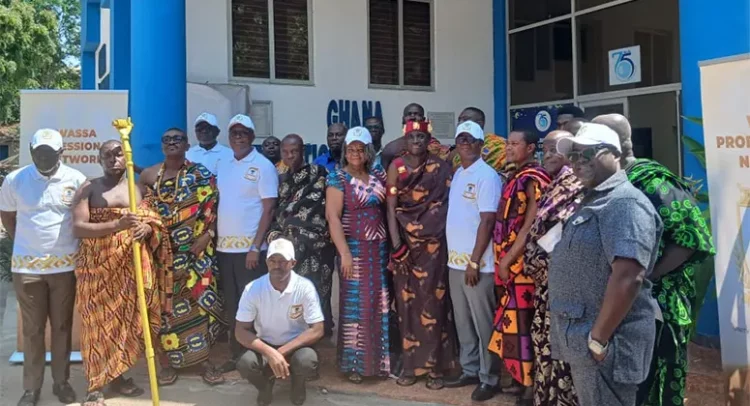
WPN members with traditional leaders in a group photograph
The Wassa Professionals Network (WPN), a non-partisan advisory and advocacy group of Wassa professionals—including members in the diaspora—working to advance development across Wassa communities, is demanding for a 10 per cent community equity and a 2 per cent direct quarterly revenue share in all mining lease renewals in the area.
Speaking at a press conference, the President of WPN, Justice Cobbinah, mentioned that the proposed arrangement is necessary to ensure that communities whose lands host valuable mineral resources benefit directly and meaningfully from the wealth generated by mining activities.
“Our position is straightforward: If the gold beneath Wassa creates wealth for Ghana and investors, the people whose ancestral lands host that wealth must also own a meaningful part of the prosperity it creates,” he stated.
Mr. Cobbinah stressed that whether the mine was operated by a Ghanaian or foreign investor, the most important consideration should be a fairer ownership structure and a sustainable development for the people of Wassa.
He further proposed three fundamental conditions for future mining arrangements within the Wassa enclave; a 10 per cent free-carried equity interest in mining operations, to be held through an accountable Wassa Trust Fund on behalf of host communities.
Also, a direct allocation of a 2 per cent of gross mineral sales revenue, payable quarterly into the proposed Trust Fund, without deductions for operating costs, debts or management fees and a formal representation of indigenous Wassa communities, through the WPN, in mining lease transition arrangements, relevant negotiations and the governance structures of future mining operations.
The President emphasised that the proposed benefits should be additional to, and not a replacement for statutory royalties, taxes, lawful compensation, environmental restoration obligations or existing community development commitments.
He added that the proposed equity and revenue-sharing arrangements would establish a more equitable and sustainable partnership between government, investors and indigenous host communities, arguing that communities should not merely be recipients of development projects and corporate social responsibility (CSR) interventions, but should become recognised stakeholders in the ownership, decision-making and long-term economic benefits of mining operations.
He reiterated that the future of mining in Wassa must be guided by principles of fairness, accountability, inclusion and sustainable development, ensuring that the benefits of the area’s mineral wealth is translated into lasting prosperity for present and future generations.
The traditional leaders of Wassa also used the opportunity to appeal to the government for the construction of the Wassa and Tarkwa to Accra roads.
By Florence Adom Asamoah