

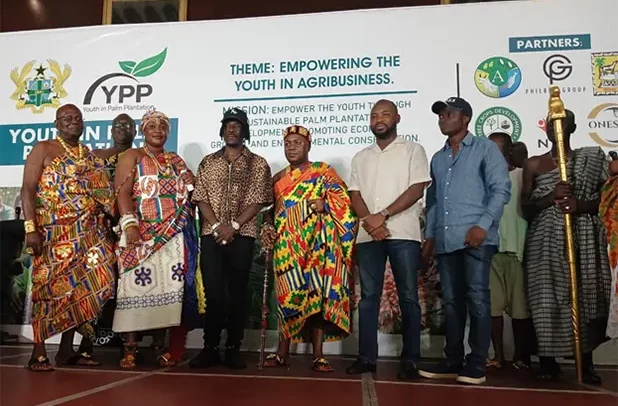
Osaberima Asare Twe II (M) and officials in a group photograph
Philbro Group, in partnership with the National Youth Authority, the Ministry of Employment and Labour Relations and Kade Traditional Council has launched the Youth in Palm Plantation aimed at empowering young people in agribusiness.
The Youth in Palm Plantation initiative will help promote oil palm cultivation as a lucrative and sustainable business opportunity for young people nationwide.
Chief Executive Officer of Philbro Group, Philip Nana Kwame Brobbey, speaking at the media launch in Accra said over 3,000 young Ghanaians have submitted applications to join the agribusiness programme focused on addressing unemployment and promoting sustainable livelihoods.
”Beyond creating employment, the programme is expected to contribute to reducing youth unemployment while boosting local production in Ghana’s agricultural sector, particularly within the oil palm value chain,” he noted.
Osaberima Asare Twe II, Kadehene also announced plans for a Palm Festival aimed at creating jobs for the youth and curbing illegal mining (galamsey) by converting degraded lands into oil palm plantations.
He revealed that the Kade Traditional Council plans to allocate between 20-30 thousand acres of land to support the youth who are interested in agribusiness.
Oil Palm Value Chain Specialist at the Tree Crop Development Authority (TCDA), Yaw Agyei-Agyapong highlighted that Ghana’s target to develop more than 100,000 hectares of oil palm will significantly boost job creation, particularly for young people.
”The oil palm sector in Ghana has been identified as a major driver of youth employment, entrepreneurship, and rural industrialisation, with the potential to create over 250,000 jobs as part of a national expansion plan,” he noted.
According to him, opportunities for the youth span the entire oil palm value chain, including nursery development, certified seedling production, plantation management, harvesting, processing, logistics, and marketing.
He said the TCDA plays a central role in promoting youth participation in the sector, adding that, the Authority is facilitating access to improved planting materials, supporting out grower schemes, strengthening quality standards, and providing technical training and certification.
”It is also implementing digital systems to enhance traceability and transparency, while building partnerships to integrate young farmers and entrepreneurs into structured markets,” he added.
Furthermore, he mentioned that, the government’s proposed Integrated Oil Palm Development Policy is expected to strengthen youth inclusion through access to long-term financing, subsidised inputs, and technical support.
”The policy will also promote small-holder integration and establish dedicated funding windows to improve access to affordable credit, particularly for youth and women,” he noted.
In addition, he said the initiative will further support youth-focused programmes in processing, mechanisation, and agribusiness development to ensure inclusive participation across the oil palm value chain.
Chief Executive Officer (CEO) of National Youth Authority (NYA), Osman Abdulai Ayariga Esq., commended the Kade Traditional Area and stakeholders for introducing a timely programme that places young people at the centre of agribusiness development.
The initiative, he said, will provide practical training, mentorship, and access to finance to help the youth transition into productive ventures,” he highlighted.
He also encouraged young people to support local businesses and leverage government programmes to move from consumption to production, stressing that agriculture remains a key driver of economic growth and job creation.
By Janet Odei Amponsah